Key Takeaways
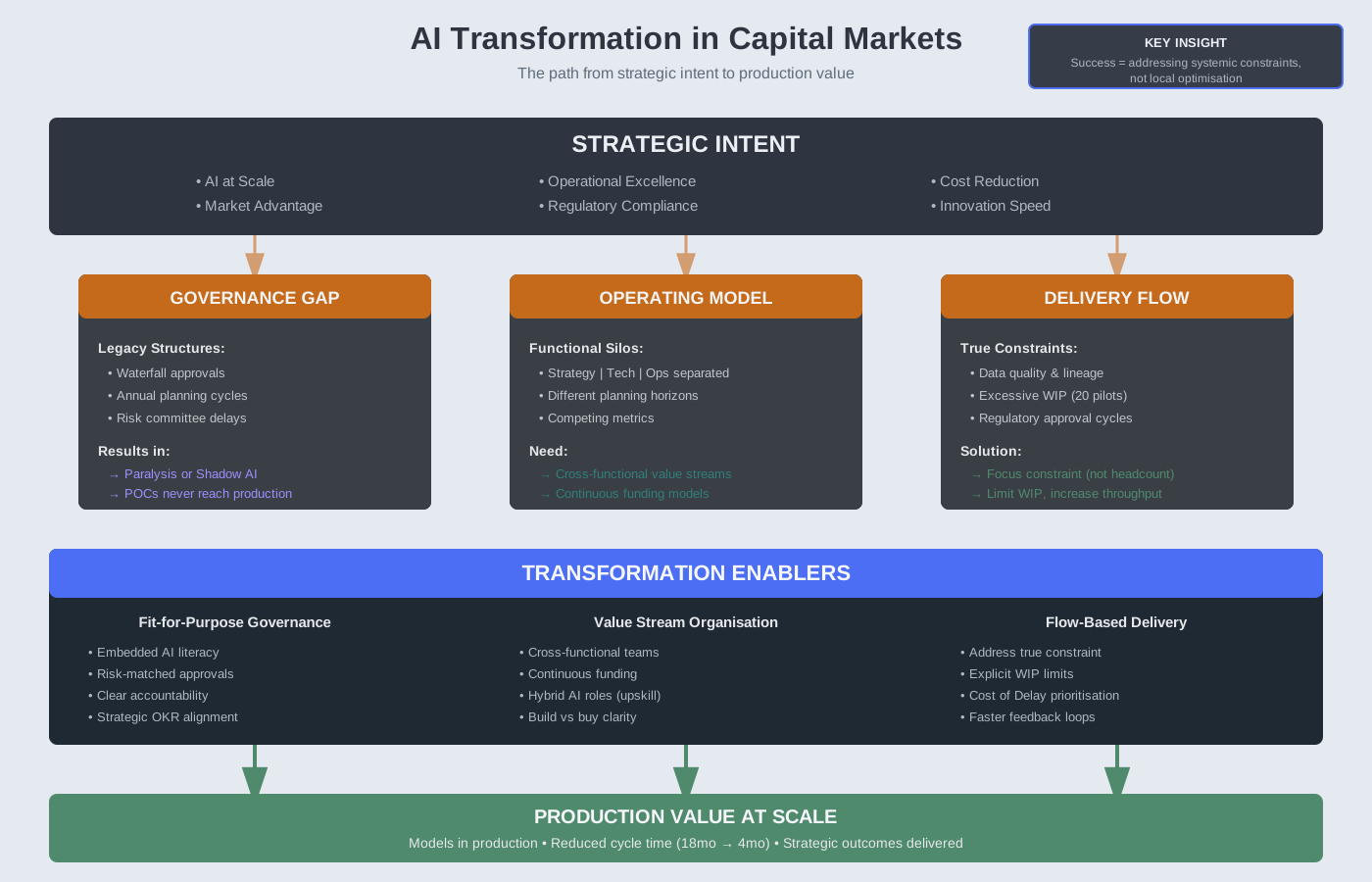
- Capital markets firms face a governance gap in AI transformation, leading to paralysis or shadow AI due to outdated frameworks.
- Effective AI transformation requires governance that imbues AI literacy in decision-making and balances innovation speed with control.
- Leading CIOs redesign operating models around value streams to enhance cross-functional collaboration and improve performance measurement.
- Delivery flow must adapt to continuous AI models rather than traditional project timelines, addressing systemic bottlenecks for timely production.
- Integrating AI governance with strategic objectives through frameworks like OKRs ensures alignment of initiatives with measurable business outcomes.
Most CIOs and COOs in capital markets know their organisations must adopt AI at scale. Yet few can articulate how AI transformation actually changes governance structures, operating models, or delivery flow. The result: isolated proofs of concept that never reach production, and strategic ambiguity where clarity is needed most.
The governance gap in AI transformation
Capital markets firms, like their insurance market counterparts, face a structural challenge. AI transformation demands decisions about data sovereignty, model risk, regulatory compliance, and organisational accountability, yet most governance frameworks were designed for Waterfall delivery and stable technology stacks. When a tier-one investment bank attempts to deploy generative AI for trade reconciliation, the existing change approval board lacks both the technical literacy and the decision cadence to evaluate risk intelligently.
This governance gap creates two failure modes. The first is paralysis: AI initiatives stall in risk committees whilst competitors ship working systems. The second is shadow AI: business units deploy unvetted models outside formal governance, creating regulatory exposure and operational fragility. Both outcomes stem from the same root cause-governance structures that treat AI as a technology project rather than an operating model transformation. AI shouldn’t be causing Failure Demand. Instead it should be deployed to expedite value.
Effective AI transformation requires governance that balances innovation speed with appropriate control. This means embedding AI literacy into decision-making forums, creating fit-for-purpose approval pathways for different model types, and establishing clear accountability for AI outcomes across the organisation. Without this structural change, even well-funded AI programmes fail to deliver enterprise value.
Making Sense of AI Strategy
Move beyond the hype with a vendor-neutral roadmap for Capital Markets.

AI Strategy & Opportunity Validation
We help firms identify where AI creates genuine competitive advantage and where it introduces unnecessary risk. Our output is a rigorous set of recommendation that prepares your team(s) for successful implementation.
Learn MoreOperating Model implications for CIOs
AI transformation reshapes how capital markets firms organise capability, allocate resources, and measure performance. Traditional operating models separate strategy, technology, and operations into distinct functions with annual planning cycles. AI-enabled organisations require cross-functional product teams, continuous funding models, and real-time performance visibility.
Consider a global asset manager implementing AI-driven portfolio optimisation. The legacy operating model assigns quantitative researchers to the front office, data engineers to technology, and risk analysts to a separate function. Each group operates on different planning horizons and success metrics. When AI transformation demands integrated teams that iterate rapidly on model performance, the operating model becomes the constraint.
Leading CIOs are redesigning operating models around value streams rather than functional silos. A value stream, such as “client onboarding” or “regulatory reporting,” encompasses all capabilities required to deliver customer value, including AI model development, data engineering, and operational deployment. This structure enables the fast feedback loops essential for AI effectiveness whilst maintaining appropriate risk controls.
Capability architecture and skills
AI transformation exposes capability gaps that cannot be addressed through hiring alone. Capital markets firms need AI product managers who understand both model performance and business value, MLOps engineers who can industrialise model deployment, and business analysts who can identify high-value AI use cases. These hybrid roles rarely exist in traditional job architectures.
The solution lies in systematic capability building rather than purely external recruitment. Successful COOs establish internal AI academies that upskill existing talent, create career pathways that reward cross-functional expertise, and partner with universities to build talent pipelines. One European bank reduced AI delivery cycle time by 63% by training business analysts in prompt engineering and decision scientists in Agile delivery practices.
Equally important is the decision about which AI capabilities to build internally versus consume as services. Wardley Mapping, a technique for visualising the evolution and strategic value of capabilities, helps leadership teams identify where proprietary AI models create competitive advantage and where commoditised AI services suffice. Most firms discover they should build custom models only for differentiating activities like alpha generation or client personalisation, whilst consuming AI services for undifferentiated functions like document processing.
Delivery Flow and AI implementation
AI transformation fails when organisations treat it as a technology deployment rather than a continuous delivery challenge. Unlike traditional systems that reach a stable end state, AI models require ongoing monitoring, retraining, and refinement. This reality demands fundamental changes to delivery flow – the system by which work moves from idea to production value.
Flow principles, grounded in Theory of Constraints and Lean thinking, provide a practical framework for AI transformation. The core insight: system throughput is determined by the constraint, not by local optimisation. In Capital Markets’ AI programmes, the constraint is rarely compute capacity or model accuracy. It is typically one of four systemic bottlenecks:
- Queues: An incredibly under appreciated and often overlooked. There’s very little point in producing something 32x faster, if the organisation can’t process the next step. All that happens is you created a bigger backlog 32x faster.
- Data access and quality: Processing bad input simply produces a lot of bad output (sometimes in extremis). It’s important that your AI deployment strategy includes looking at your data.
- Regulatory approval processes: In heavily regulated business environments, such as Capital Markets, regulatory approval often acts as a bottleneck and so must be factored in to any AI strategy.
- Organisational change capacity: Can the organisation manage the change that AI will bring? It’s an important question, akin to the old adage that 80% of all documents written are never read… yet it’s a factor that’s most usually overlooked.
In addition to Flow principles, and complementary to them as a part of the Lean thinking movement, is Lean Portfolio Management. Using this tool helps to provide the structure and rigour required to give you full visibility of your portfolio – both AI and non-AI; after all, the two exist side-by-side. With the right combination of tools, you can get clarity and value quickly (see related article: How to run a Flow to Value delivery in just eight weeks).
A multinational trading firm discovered its AI delivery constraint was data lineage documentation. Models were ready for production, but risk committees required complete audit trails of training data provenance, a process that took six months per model. By addressing this constraint through automated data cataloguing and embedded lineage tracking, the firm reduced time-to-production from nine months to six weeks. This single intervention delivered more value than doubling the size of the data science team.
Managing Work in Progress
Traditional project governance encourages starting multiple AI initiatives simultaneously to “maximise resource utilisation”. This approach ignores the mathematics of queuing theory: as work-in-progress increases, cycle time rises exponentially whilst throughput remains flat or declines. The result is dozens of AI pilots that never reach production.
Effective delivery flow requires explicit work-in-progress (WIP) limits. Rather than funding 20 AI experiments, leading CPTOs / CTO, and CIOs fund five initiatives with the resources and executive attention to reach production, then initiate new work only as capacity becomes available. This approach feels counterintuitive – fewer concurrent projects should deliver less value – but empirical results consistently show higher throughput and faster time-to-value.
One Asia-Pacific bank implemented WIP limits across its AI portfolio, capping active initiatives at seven. Within two quarters, the number of models in production increased from three to 14, and the average time from concept to deployment fell from 18 months to four months. The mechanism: reducing multitasking enabled teams to resolve blockers faster, and limiting demand forced executives to prioritise initiatives by Cost of Delay – the economic impact of deferring value delivery.
Integrating AI governance with strategic objectives
AI transformation creates value only when aligned with clear strategic objectives. Yet many capital markets firms struggle to connect AI initiatives to measurable business outcomes. The solution lies in integrating AI governance with existing strategy frameworks, particularly OKRs (Objectives and Key Results) and Balanced Scorecard approaches.
OKRs provide a mechanism for cascading strategic intent into actionable AI investments. A global custody bank established the objective “Reduce operational risk through intelligent automation” with key results including “Decrease reconciliation breaks by 40%” and “Achieve 99.5% STP rate for corporate actions”. AI initiatives were then evaluated and funded based on their contribution to these specific outcomes, not on technical sophistication or innovation theatre.
The Balanced Scorecard framework extends this alignment by mapping cause-and-effect relationships between AI capabilities and strategic outcomes. When a wealth manager identified “client retention” as a strategic priority, the Balanced Scorecard revealed that retention correlated with advisor productivity, which depended on AI-augmented client insights. This causal chain enabled the COO to prioritise AI investments in next-best-action recommendation engines over technically impressive but strategically disconnected initiatives like robo-advisory.
Decision intelligence and economic prioritisation
AI transformation decisions involve uncertainty, opportunity cost, and competing stakeholder interests. Cost of Delay, a decision framework from Lean Portfolio Management (LPM), provides economic clarity when intuition fails. By quantifying the value lost per unit of time an initiative is delayed, leadership teams can compare dissimilar AI investments on a common scale.
Consider two AI initiatives: an algorithmic trading optimisation expected to generate ~£2 million annually, and a regulatory reporting automation saving ~£500k annually. Intuition suggests prioritising the trading system. However, Cost of Delay analysis reveals the regulatory project faces a compliance deadline six months away, creating a step-function cost of ~£5 million if delayed. The economically rational choice becomes clear: deliver the regulatory automation first despite its lower steady-state value.
Practical next steps for senior leaders
- Audit current governance structures: Identify where AI decisions are stalling or bypassing formal approval. Establish fit-for-purpose governance pathways that match risk profile to decision speed. Low-risk AI applications* should not require the same approval process as systemically important trading algorithms.
- Map your AI delivery flow: Visualise how AI initiatives move from concept to production value. Identify the true constraint, often data quality, regulatory approval, or change capacity, and focus improvement efforts there rather than adding headcount to unconstrained activities.
- Establish clear economic prioritisation: Implement Cost of Delay quantification for AI investments. Train leadership teams to evaluate initiatives based on the economic impact of delay, not just projected ROI or strategic alignment scores.
- Define AI-enabled operating model principles: Articulate how value streams, funding models, and capability architecture must evolve. Create cross-functional product teams aligned to business outcomes rather than functional silos, and shift from project-based to continuous funding for strategic AI capabilities.
- Build organisational AI literacy systematically: Establish internal capability development programmes that upskill existing talent rather than relying solely on external hiring. Focus on hybrid roles that combine domain expertise with AI product skills, and create career pathways that reward cross-functional capability.
Conclusion
AI transformation in capital markets succeeds not through technology prowess alone, but through deliberate changes to governance, operating models, and delivery flow. The firms that embed AI into strategic decision-making, create cross-functional delivery structures, and manage work as an economic system will compound advantages that competitors cannot easily replicate. This requires senior leaders to challenge existing organisational assumptions and design for systemic performance rather than local optimisation.
Strategic Flow would welcome a conversation if you are exploring how to embed AI transformation into your governance structures and delivery flow. Our approach integrates strategy frameworks, Flow analytics, and AI-enabled operating models to help capital markets leaders achieve delivery confidence at scale.