Key Takeaways
- Failure demand accounts for up to 60% of operational capacity, resulting from initial errors and creating no new value.
- It often leads to increased costs, longer delivery times, and accumulated technical debt in organisations.
- Traditional performance metrics overlook failure demand, rewarding output without recognising the underlying issues.
- Implementing first-time-right capability helps organisations reduce failure demand by understanding work context and aligning delivery methods.
- To combat failure demand, organisations should measure it, identify its sources, and establish structural changes to prevent its creation.
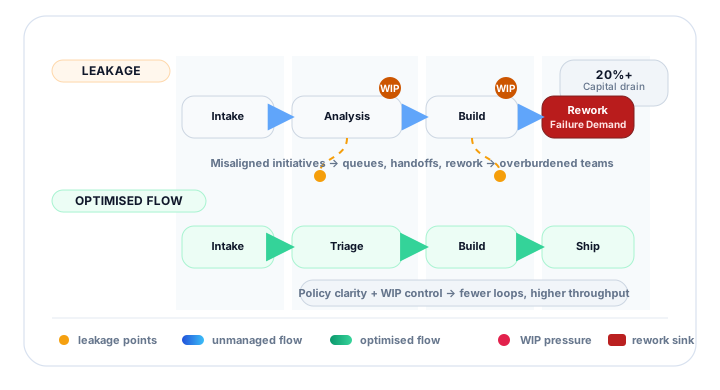
Most organisations measure output, velocity, and delivery pace. Few measure how much work exists only because something failed the first time. Failure demand consumes as much as 60% of operational capacity in complex delivery environments, yet remains invisible to traditional performance frameworks. That means more than half of the work being done is being done because it wasn’t done right first time!
The hidden cost structure of rework
Failure demand describes work created by failure to do something right initially. Unlike Value demand (customer requests that create genuine value), failure demand generates no new value. It merely moves the system further toward the state it should have reached originally. In Capital Markets infrastructure, this appears as post-deployment fixes, customer complaint handling, manual workarounds for broken automation, and emergency patches that consume capacity meant for strategic initiatives.
The economic impact extends beyond immediate rework costs. Each failure demand item displaces value-generating work, extends delivery timelines, and compounds technical debt. When a trading platform deployment requires three rounds of remediation, the opportunity cost includes delayed revenue, eroded stakeholder confidence, and constrained capacity for innovation. A recent analysis of 23 financial services transformation programmes revealed that organisations spend an average of £1.3m annually on failure demand in technology delivery alone, representing 41% of total delivery capacity.
The systemic nature of failure demand means it rarely appears in isolation. One failure triggers cascades: incomplete requirements generate rework, which creates rushed testing, which produces escaped defects, which demand emergency fixes, which introduce new failures. This amplification effect explains why some organisations struggle to escape reactive firefighting despite adding resources or accelerating processes.
Why traditional metrics miss failure demand
Conventional performance frameworks optimise for the wrong outcomes. Teams measured on velocity increase output without distinguishing between value demand and failure demand. This creates perverse incentives: resolving ten support tickets generates the same velocity credit as delivering ten new features, despite vastly different value contributions. Organisations appear productive whilst accumulating failure demand that constrains future capacity.
Throughput metrics compound this visibility gap. Leadership dashboards show features delivered, stories completed, and initiatives launched. They rarely quantify how many items represent corrections to previous work. In insurance policy administration systems, for example, standard reporting might show 200 completed work items quarterly. Deeper analysis often reveals that 119 items addressed failures in prior releases, leaving only 81 items of genuine value demand – that 60% again.
The problem intensifies in complex environments where failure demand manifests as hidden operational friction rather than explicit rework tickets. Manual reconciliation processes, shadow systems, duplicate data entry, and defensive checking procedures all represent failure demand disguised as “business as usual”. These practices become normalised, embedded in process documentation, and defended as necessary controls rather than recognised as symptoms of upstream failures.
The systemic sources of failure demand
Failure demand originates from four primary sources, each requiring different intervention approaches. Understanding these patterns enables targeted reduction rather than broad quality initiatives that fail to address root causes.
Incomplete understanding at initiation
Work begins before sufficient context, requirements, or constraints are understood. In data centre infrastructure projects, for example, this appears as deployments that meet stated specifications but fail operational reality. A facility might achieve contractual uptime targets whilst generating continuous failure demand through inadequate cooling capacity, inefficient power distribution, or incompatible monitoring systems. The original specification was “complete” by traditional measures, yet fundamentally incomplete for actual needs.
Misaligned capability and context
Organisations apply standardised delivery methods regardless of work context. Flow-based delivery recognises that different work types demand different approaches. A critical regulatory compliance requirement needs different treatment than an experimental feature trial. When organisations treat all work identically, they generate failure demand through inappropriate methods: inadequate testing for high-risk changes, excessive process for low-risk experiments, or uniform deployment schedules that ignore market timing.
Structural disconnection
Silos between strategy formulation, delivery execution, and operational support create information gaps that manifest as failure demand. Strategic initiatives launch without operational input, delivery teams build solutions without understanding support constraints, and operations creates workarounds without feeding insights back to strategy. Each handoff introduces failure potential. The resulting solutions work in isolation but fail at integration points, generating continuous failure demand across organisational boundaries. This distribution of failure demand tends to be multiplicative rather than merely additive in its effects.
Accumulated technical, process, and risk debt
Past compromises compound into structural fragility. Every “temporary” workaround that becomes permanent, every skipped refactoring activity, and every process exception creates future failure demand. In financial services trading infrastructure, legacy integration patterns might generate acceptable failure rates initially. As the system scales, these patterns amplify failures exponentially. What appeared as 3% failure demand at modest volumes becomes 57% at scale, yet leadership attributes the problem to growth rather than accumulated debt.
First-time-right as strategic capability
Organisations that eliminate failure demand develop first-time-right capability – the ability to understand, design, and deliver solutions that achieve intended outcomes without subsequent correction. This differs fundamentally from defect reduction or quality assurance programmes. First-time-right operates as an upstream intervention, preventing failure demand creation rather than managing it downstream.
Capital markets firms with mature first-time-right capability demonstrate three distinctive characteristics. They invest disproportionately in understanding work before starting execution, using techniques like Wardley Mapping to surface hidden dependencies and strategic context and OKRs to ensure the robust connection of strategy to its execution. They match delivery methods to work context through Fit-for-Purpose organisational design, applying appropriate rigour without uniform bureaucracy. They close feedback loops systematically, ensuring operational reality informs strategic planning and delivery design.
The economic advantage compounds over time. Organisations operating with 60% failure demand that reduce this to 20% don’t simply gain 40% capacity. They eliminate the cascade effects that amplify initial failures, reduce context switching that destroys knowledge work productivity, and free cognitive capacity for innovation rather than firefighting. The same delivery organisation achieves 3x effective capacity without adding resources.
See also: Build delivery confidence even as strategic priorities shift
Measuring and surfacing failure demand
Visibility precedes improvement. Most organisations lack metrics that distinguish failure demand from value demand. Establishing this distinction requires examining work items at intake and classifying by origin. Value demand originates from external customer needs or strategic initiatives. Failure demand originates from correcting previous work. This classification must occur at the point work enters the system, not retrospectively, to avoid rationalisation bias.
Flow analytics provides the measurement infrastructure. By tracking work from inception through deployment and subsequent lifecycle, organisations identify which items generate downstream failure demand. A trading platform feature that requires five subsequent fixes carries total cost including all downstream rework. Traditional project accounting closes the book at initial deployment, hiding the economic reality. Flow metrics maintain visibility across the full value stream, revealing true cost structures.
Three specific metrics illuminate failure demand patterns:
Failure demand ratio measures the proportion of work addressing previous failures. Target ratio varies by context, but 20% represents a reasonable threshold for complex financial services delivery.
Repeat work rate tracks how often delivered items require subsequent correction within 90 days
Touch time versus lead time reveals how much elapsed time reflects active work versus delays caused by rework, clarification, or correction cycles
Building failure demand prevention into Flow
Prevention requires structural change, not exhortation for quality. Organisations eliminate failure demand by redesigning how work flows through the system, applying explicit policies that prevent failure creation.
Establish explicit understanding gates. Work cannot progress to execution until sufficient understanding exists. This doesn’t mean exhaustive upfront planning. It means appropriate exploration matching work context and risk profile. For exploratory innovation work, understanding might mean clear hypotheses and success criteria. For regulatory implementation, understanding might demand detailed impact analysis across affected systems. The gate enforces context-appropriate rigour, not uniform process.
Implement pull-based progression. Teams pull work when they have capacity to complete it properly, rather than having work pushed regardless of capacity. This prevents the rushed execution that generates failure demand. In insurance underwriting system development, pull-based flow might mean refusing to start a new feature until enough current features complete testing, deploy successfully, and prove stable in production that capacity can then be released to work on it effectively. This creates natural WIP limits that prevent overload and maintain quality.
Build fast feedback loops. Failure demand thrives in environments with delayed feedback. When deployment occurs months after design, failures compound before anyone recognises the pattern. Organisations that eliminate failure demand deploy frequently, measure continuously, and respond immediately. This doesn’t require perfect delivery. It requires rapid learning cycles that expose failures whilst they remain small and correctable.
Match delivery methods to work characteristics. Apply Theory of Constraints thinking to identify which types of work generate disproportionate failure demand, then redesign delivery approaches specifically for those contexts. If integration testing produces 73% of escaped defects, the constraint lies in integration understanding. Addressing this might mean earlier architecture reviews, incremental integration strategies, or enhanced test environments. The intervention targets the systemic constraint, not generic quality improvement.
The organisational change dimension
Technical process changes fail without corresponding shifts in organisational behaviour and incentive structures. First-time-right capability requires leaders who prioritise sustainable delivery over immediate output, teams empowered to refuse work they cannot complete properly, and metrics that reward value delivered rather than activity completed.
This represents a fundamental shift from output-oriented to outcome-oriented performance management. Traditional delivery confidence comes from hitting deadlines and completing planned work. Flow-based delivery confidence comes from eliminating failure demand and delivering genuine value. The transition demands patience; failure demand reduction often reduces short-term velocity as teams invest in understanding before execution and refuse to accumulate technical debt.
Leadership teams must explicitly choose this path and protect teams during the transition. When a delivery team reduces velocity by 30% whilst simultaneously reducing failure demand by 60%, this represents profound improvement in value delivery. Yet traditional metrics frame this as performance decline. Leaders must recognise and communicate the economic reality: less activity producing more value.
Practical next steps
Leaders seeking to eliminate failure demand should focus on three immediate actions:
Measure current failure demand ratio by classifying work intake for one delivery stream over 30 days, distinguishing items that address previous work from items delivering new value
Identify the primary failure demand source using root cause analysis on the top 5 failure demand items, looking for systemic patterns rather than individual defects
Implement one structural intervention that prevents the dominant failure source, such as explicit understanding gates, pull-based work initiation, or enhanced feedback loops from operations to delivery
Pinpoint what it is that’s causing slow delivery – it’s normally one of only a few structural issues that when fixed can increase value delivery with a corresponding decrease in Failure Demand
Building delivery confidence through elimination
Failure demand represents the largest source of hidden waste in complex delivery environments. Organisations that surface and eliminate it transform delivery economics without adding resources or accelerating processes. They simply stop doing work that should never exist.
This shift from managing failure demand to preventing it marks the transition from reactive to strategic delivery capability. It enables genuine delivery confidence – the ability to commit to outcomes and achieve them without continuous correction, rework, or firefighting.
If your organisation spends capacity on work that exists only because something failed previously, Strategic Flow would welcome a conversation about measuring failure demand and building first-time-right capability into your delivery systems.