
This page describes how we approach problems of strategy, execution, and organisational design when working with leadership teams.
Our work is based on a small set of assumptions about how organisations behave under load, and why well-intended strategies fail in execution:
Behaviour following systems design
Incentives explain outcomes
Execution failure is structural, not motivational
When these assumptions are ignored, organisations add process, governance, and tooling. The result is they get slower, not more efficient.
Why organisations struggle
Most organisations do not struggle because they lack ambition, intelligence, or effort.
They struggle because their systems do not reliably translate intent into outcomes.
This page explains how we think about that problem and why we approach it the way we do.
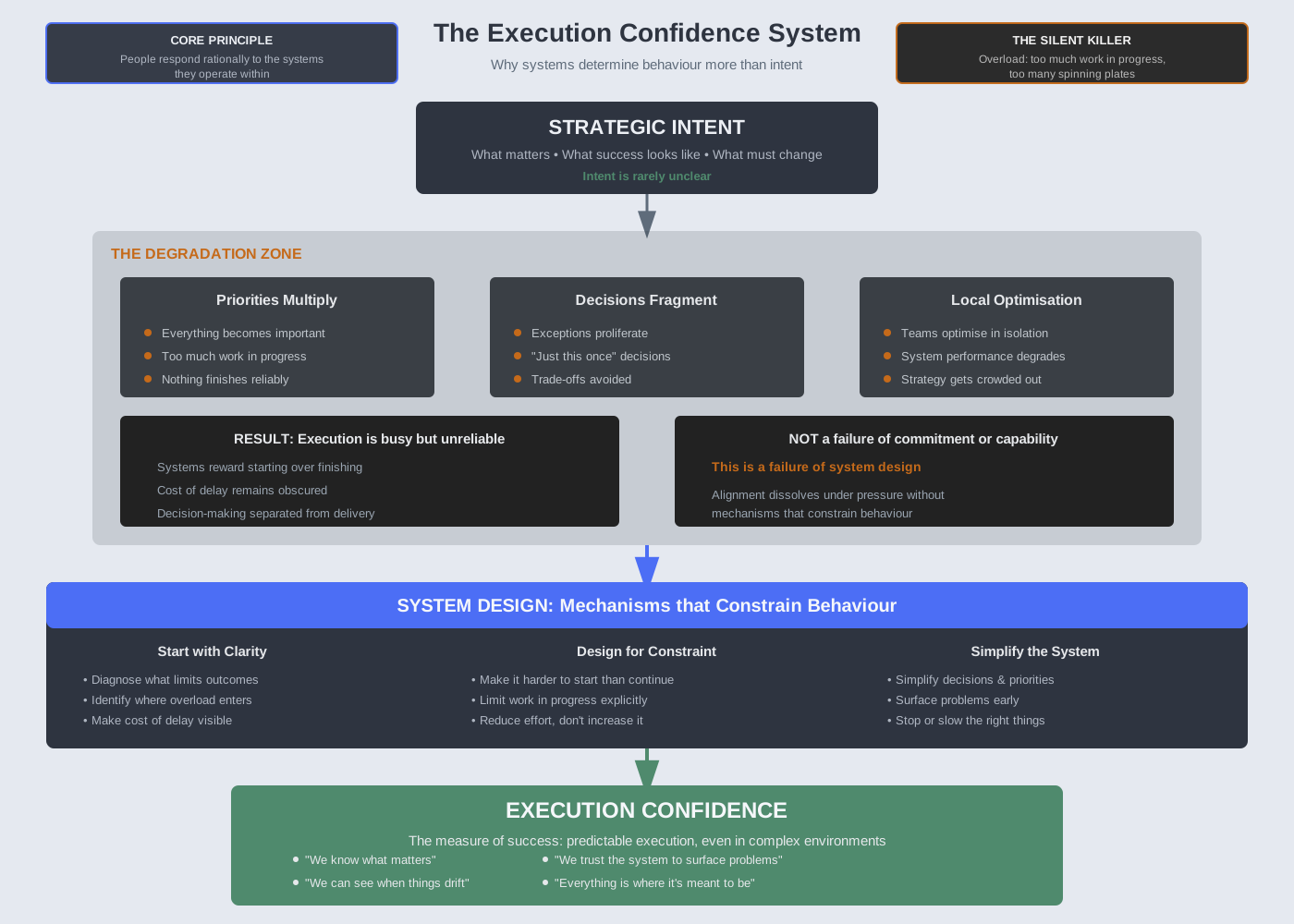
Strategy rarely fails at the point of definition
In many organisations, strategy is not unclear. It’s unseen.
Many leadership teams can articulate:
What matters
What success looks like
What must change over time
The problem is not intent.
It is what happens next.
As strategy moves into the organisation:
Priorities multiply
Decisions fragment
Local optimisation increases
Confidence erodes
Execution becomes busy, but unreliable. Meanwhile strategy gets crowded out by that execution busyness.
This is not a failure of commitment or capability.
It is a failure of system design.
Alignment is not enough
Most transformation efforts focus on alignment:
Aligning teams to goals
Aligning metrics to strategy
Aligning plans across functions
Alignment helps. Briefly.
But that alignment rarely holds under pressure.
When demand increases, deadlines loom, or new opportunities appear, alignment gives way to:
- Exceptions
- Special cases
- “Just this once” decisions
Without constraint, alignment dissolves.
Overload is the silent killer of execution
In almost every organisation, the underlying issue is not skill or motivation.
It is too much work in progress – too many spinning plates.
When everything is important:
- Nothing finishes
- Trade-offs are avoided
- Progress slows
- Decision quality declines
Execution problems are often framed as delivery issues.
In reality, they are prioritisation and decision problems.
Until the system makes it harder to start work than to continue it, execution will remain unpredictable.
Systems determine behaviour more than intent
People respond rationally to the systems they operate within.
If the system:
- Rewards starting over finishing
- Allows priorities to expand unchecked
- Obscures the cost of delay
- Separates decision-making from delivery
…then even the best strategy will degrade.
Sustainable execution requires mechanisms that hold strategic intent in place, even when conditions change.
That is a design problem, not a communication problem.
Frameworks are tools, not answers
We use frameworks where they sharpen insight or enable better decisions.
We avoid them where they:
- Become the focus of the work
- Are applied dogmatically
- Replace thinking with compliance
No single framework fits every context. As the old saying goes, “all models are wrong, some are useful.”
The question is never:
“Which framework should we adopt?”
Rather, it is:
“What mechanism will most effectively constrain behaviour in this system?”
Sometimes that involves Objectives and Key Results.
Sometimes it doesn’t
The framework is secondary.
The effect on the system is what matters.
Change should reduce effort, not increase it
If an intervention:
- Adds reporting
- Increases coordination overhead
- Creates new roles without removing old ones
- Requires constant enforcement
It will fail. We’ve seen it again and again.
Effective change simplifies:
- Decisions
- Priorities
- Conversations
- Ways of working
The goal is not transformation theatre.
It is calmer, more reliable execution.
Clarity comes before change
Before altering structures, processes, or incentives, leaders need a shared, evidence-based understanding of:
- What is actually limiting outcomes
- Where overload is entering the system
- Which decisions matter most
- What should be stopped or slowed down through reprioritisation
Change without clarity creates motion, not progress. This distinction matters most in complex, interdependent, or regulated environments where intuition alone is insufficient.
That is why our work begins with diagnosis and only moves to design when the system is understood.
The measure of success is confidence
The ultimate outcome we look for is not velocity, maturity scores, or adoption metrics.
It is execution confidence.
When leaders can say:
“We know what matters”
“We can see when things are drifting”
“We trust the system to surface problems early”
“We know that everything is where it is meant to be”
Execution becomes predictable, even in complex environments.
This way of thinking reflects patterns observed repeatedly across different sectors, organisational sizes, and operating models.
That is the standard we work to.
How this thinking shapes our work
This perspective underpins:
The approach is deliberate, system-level, and evidence-led.
It is designed to reduce noise, not create it.
Final note
If this way of thinking resonates, you will likely find the rest of the site familiar.
If it doesn’t, that’s useful too.
Clarity cuts both ways.
Ready to apply this thinking to your business?
Start a Strategy DiagnosticFurther Reading:
Diversity and inclusion in transformation: why It matters
Build delivery confidence even as strategic priorities shift