Key Takeaways
- Most portfolio leaders depend on intuition and negotiation, yet quantifying Cost of Delay can enhance decision-making and operational efficiency.
- Cost of Delay (CD3) measures the economic impact of delays on value delivery, helping prioritize initiatives based on their financial consequences.
- CD3 reveals strategic insights by balancing revenue loss, risk mitigation, and competitive advantage in portfolio management.
- Traditional frameworks often overlook timing’s role in value creation; CD3 enables more informed, dynamic prioritisation that aligns with actual business economics.
- Integrating CD3 with Flow practices optimizes delivery, ensuring that high-CD3 initiatives receive focused investment and minimal multitasking to enhance throughput.
Most portfolio leaders allocate investment using intuition, political negotiation, and high-level business cases – or worse, some kind of scale that few understand, especially senior leaders. Yet the organisations that quantify Cost of Delay systematically outperform peers by 3-5x, even 9x, in time-to-value, because they’ve made the economic impact of waiting visible, measurable, and actionable.
The hidden economics of portfolio decisions
In capital markets technology, EV charging infrastructure, and insurance platforms, every quarter a strategic initiative sits in the backlog represents tangible economic loss. Revenue doesn’t materialise. Competitive positioning erodes. Regulatory exposure compounds. Yet most portfolio management frameworks treat delay as a scheduling inconvenience rather than the strategic liability it truly represents.
Cost of Delay (CD3) changes this equation fundamentally. It quantifies the financial consequence of deferring work, enabling portfolio leads to make evidence-based prioritisation decisions that align with actual business economics. Unlike traditional ROI calculations that focus solely on returns, CD3 reveals the opportunity cost structure of your entire portfolio, illuminating which initiatives unlock disproportionate value when accelerated, and which destroy strategic momentum when delayed.
The challenge isn’t theoretical. A Tier 1 investment bank recently discovered that delaying a regulatory compliance initiative by six months to prioritise a revenue-generating digital trading platform would have triggered a potential £137 million in regulatory fines, dwarfing the platform’s projected first-year revenue of £12 million. Their traditional WSJF scoring system had ranked compliance dead last. CD3 analysis reversed that decision within a single portfolio review session.
What Cost of Delay actually measures
Cost of Delay quantifies the economic impact of time on value delivery. Specifically, it answers a deceptively simple question: what does it cost the organisation for this work to be delayed by one week, one month, or one quarter?
This isn’t about project completion dates or milestone tracking. CD3 measures the ongoing financial consequence of work not being in production, not serving customers, not generating returns, or not mitigating risk. It makes delay visible as an economic variable that compounds daily, not a scheduling abstraction that leaders can negotiate away.
The power of CD3 lies in three distinct measurement dimensions:
- Revenue or value generation impact. This captures direct financial consequences – lost sales, unrealised efficiency gains, or foregone market opportunities;
- Risk mitigation value, which quantifies the escalating cost of unaddressed regulatory exposure, security vulnerabilities, or operational fragility; and
- Strategic positioning effects, which estimate how delay affects competitive advantage, market share capture, or option value for future capabilities.
Consider an EV charging infrastructure operator evaluating portfolio priorities. Accelerating ultra-fast charger deployment along a strategic motorway corridor doesn’t just generate incremental revenue from charging sessions; it captures network effects as drivers develop route preference, creates barriers to competitive entry in high-value locations, and generates behavioural data that informs site selection algorithms for subsequent expansion phases. Traditional NPV analysis captures only the first effect. CD3 frameworks surface all three, revealing the true cost of delay.
The CD3 formula: turning delay into decision intelligence
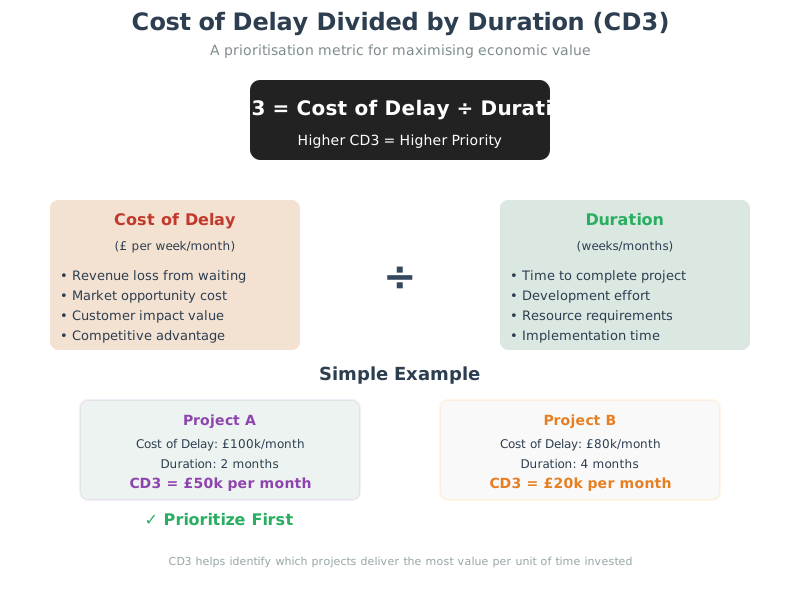
Calculating Cost of Delay requires translating strategic intuition into quantifiable economics. The canonical CD3 formula is elegantly simple:
Cost of Delay = Value Delivered / Duration
This yields a cost-per-time-period metric, typically expressed as pounds / dollars / euros per week (best) or pounds per month, that enables direct economic comparison across radically different initiative types.
This apparent simplicity conceals analytical depth. Value Delivered must incorporate both upside opportunity and downside risk mitigation. Duration should reflect actual delivery time under realistic constraints, not aspirational best-case scenarios. The resulting CD3 metric enables portfolio leads to ask:
if we could accelerate only one initiative by four weeks, which choice generates maximum economic return?
Financial services organisations often extend this formula to include urgency profiles that capture how Cost of Delay changes over time. A regulatory deadline creates a step-function urgency curve where CD3 spikes dramatically at the compliance date. A market opportunity might show exponential decay as competitors enter. Customer experience improvements typically demonstrate linear or gradually increasing CD3 as negative sentiment compounds.
The most sophisticated portfolio teams calculate CD3 across three scenarios: optimistic, realistic, and pessimistic. This reveals not just expected Cost of Delay, but the uncertainty envelope around prioritisation decisions. When a strategic initiative shows high CD3 across all scenarios, the prioritisation signal is unambiguous. When CD3 varies dramatically between scenarios, portfolio leads can invest in discovery work to reduce uncertainty before committing full delivery resources.
Why traditional prioritisation frameworks miss the point
Most portfolio management approaches – stack ranking by business value, weighted scoring matrices, cost-benefit analysis, story points (!) – share a common blind spot: they evaluate initiatives as static decisions rather than dynamic economic systems where timing creates or destroys value.
A weighted scoring framework might rate Initiative A and Initiative B similarly on strategic alignment, customer impact, and feasibility. Yet if Initiative A generates £500k per month in value whilst Initiative B generates £50k, and both take six months to deliver, their CD3 metrics reveal a 10x difference in economic urgency. Delaying Initiative A by three months to sequence Initiative B first destroys £1.5 million in value that can never be recovered. Let’s look at how this works with more of an illustrated example.
Initiative
A
B
C
Cost of Delay
£1,000 p/w
£4,000 p/w
£5,000 p/w
Time to Complete (Duration)
5 weeks
1 week
2 weeks
CD3 Score
£200
£4,000
£2,500
These CD3 scores are compounded over the time that each initiative is not available for the organisation to earn money from; in other words, until each goes live. So, we use the CD3 score to determine which we should go with first (i.e. we should do Initiative B first).
How this works:
Scenario 1: Process each request in the order received
For the 5 weeks of work on A Cost of Delay is incurred on all three items (starting at the bottom and working up):
Duration
5 Weeks
1 Week
2 Weeks
Cost of Delay
A+B+C
B+C
C
Weekly Cost of Delay (CoD)
£10k
£9k
£10k
Total CoD
£50k
£59k
£69k
For the 5 weeks we’ve not delivered anything, we’ve not had the benefit of £50k of revenue / value. Once we deliver Initiative A, we get that value so we can deduct it from the running total. Initiative B takes a week, so we are not getting the benefit of even from either B or C – a further £9k, bringing our running total of missed revenue to £59k. Lastly, for the two weeks it takes to deliver C, we are without the benefit of a further £10k, bringing the total missed value to £69k.
Scenario 2: Process each initiative in order of its CD3 score
Let’s now look at what happens if we progress using the CD3 method. We want to develop the one with the highest score first as that will lose us the least value, so the order becomes B -> C -> A. Here’s the same calculation but using this order:
Duration
1 Week
2 Weeks
5 Weeks
Cost of Delay
B+C+A
C+A
A
Weekly CoD
£10k
£6k
£1k
Total CoD
£10k
£22k
£27k
Our total missed value is now £27k instead of £69k, meaning we’ve realised £42k in additional value. That’s £42k we would otherwise not have earned. Now imagine we’re dealing with a portfolio of millions. It soon stacks up.
ROI calculations suffer from a different pathology. They measure efficiency of capital deployment but ignore the opportunity cost of time. An initiative with 300% ROI delivered in 18 months might generate less total value than a 150% ROI initiative delivered in six months, because the faster initiative enables two additional investment cycles within the same timeframe. CD3 makes this dynamic visible by focusing on value delivery rate, not just cumulative returns.
Traditional portfolio governance compounds these limitations through quarterly or annual planning cycles that treat prioritisation as a periodic event rather than a continuous flow optimisation problem. By the time the next planning cycle arrives, market conditions have shifted, competitive threats have evolved, and yesterday’s prioritisation logic no longer reflects today’s economic reality. CD3 enables continuous reprioritisation grounded in current Cost of Delay economics rather than outdated strategic assumptions.
Applying CD3 in complex portfolio environments
Implementing Cost of Delay analysis in capital markets technology or infrastructure portfolios requires navigating several practical challenges. The most common objection is quantification difficulty: how do you estimate the monetary value of improved customer experience, enhanced operational resilience, or technical debt reduction?
The answer lies in accepting bounded precision over false precision. A Cost of Delay estimate with 40% confidence intervals is infinitely more valuable than no economic visibility at all. Portfolio leads should focus on relative CD3 comparison. Is Initiative A’s Cost of Delay roughly 2x, 5x, or 10x larger than Initiative B’s? The alternative is spurious decimal-point accuracy that no one cares about.
One effective approach starts with reference class anchoring. An insurance platform modernisation initiative might anchor its CD3 estimate against the known cost of policy administration inefficiency – claim processing delays, manual exception handling, customer service escalations – that the new platform eliminates. If current inefficiency costs £200k monthly and the platform eliminates 60% of that waste, CD3 approximates £120k per month. Refinement comes from stress-testing assumptions with business stakeholders who own the cost structures.
Data centre operators have successfully applied CD3 frameworks to infrastructure investment portfolios by creating urgency profiles for different work categories. Capacity expansion shows exponential CD3 growth as utilisation approaches physical limits and service degradation risks spike. Energy efficiency improvements demonstrate linear CD3 as electricity costs accumulate steadily. Security upgrades often display step-function urgency curves tied to threat intelligence or compliance deadlines. This taxonomy enables portfolio leads to match different initiative types with appropriate CD3 calculation methodologies.
Integrating CD3 with Flow-based delivery
Cost of Delay analysis generates maximum value when integrated with Flow-based delivery practices that optimise throughput and minimise cycle time. CD3 tells you what to prioritise; Flow principles tell you how to deliver it with maximum speed and reliability.
The key insight is that Work in Progress (WIP) limits, a cornerstone of Flow methodology, should be informed by Cost of Delay economics. High-CD3 initiatives justify focused investment and minimal multitasking to accelerate delivery. Lower-CD3 work can absorb more scheduling flexibility and resource sharing without significant economic penalty.
This integration reveals systemic constraints that traditional portfolio management obscures. If your highest-CD3 initiatives consistently queue behind capacity bottlenecks in enterprise architecture review or regulatory approval, you’ve identified exactly where to invest in constraint elevation. Strategic Flow’s Delivery Confidence framework combines CD3 analysis with constraint identification to surface these leverage points systematically.
Portfolio leads should establish CD3 thresholds that trigger different delivery protocols. Initiatives above £100k per month Cost of Delay might warrant dedicated cross-functional teams with minimal dependencies. Those between £25k-£100k might use shared services with defined capacity allocation. Below £25k monthly CD3, work flows through standard delivery queues.
Practical next steps
Begin Cost of Delay implementation by selecting five to eight strategic initiatives from your current portfolio that represent different value types – revenue generation, risk mitigation, efficiency improvement, and capability building. Workshop CD3 estimates with initiative sponsors using the three-scenario approach: optimistic, realistic, and pessimistic.
Document the assumptions underlying each CD3 calculation explicitly. What revenue projections, risk probability estimates, or efficiency gains drive the numbers? This transparency enables productive challenge and refinement whilst building stakeholder confidence in the methodology. Expect initial estimates to feel uncomfortable – that discomfort signals you’re surfacing economic realities that qualitative prioritisation frameworks concealed.
Compare your CD3-based priority ranking against your current portfolio sequence. Where do they diverge significantly? These gaps represent potential value leakage – initiatives with high Cost of Delay languishing in the backlog whilst lower-CD3 work consumes delivery capacity. Quantify the opportunity cost of current sequencing to build the business case for reprioritisation.
Establish a monthly CD3 review cadence where portfolio leads and initiative sponsors revisit Cost of Delay estimates based on market changes, competitive intelligence, and delivery progress. This creates a continuous learning loop that refines economic understanding whilst enabling dynamic reprioritisation as conditions evolve. Over three to four cycles, most organisations develop genuine fluency in CD3 thinking that transforms portfolio conversations from political negotiation into evidence-based economic optimisation.
Conclusion
Cost of Delay fundamentally shifts portfolio management from intuition-driven prioritisation to economics-grounded decision intelligence. By quantifying the financial consequence of delay, CD3 reveals which initiatives unlock disproportionate value when accelerated, and which destroy strategic momentum when they consume scarce delivery capacity. Portfolio leads who master CD3 analysis gain a decisive advantage: the ability to make prioritisation decisions that align with business economics rather than political pressure or historical precedent.
The transformation isn’t merely analytical. CD3 creates a shared language for portfolio governance that bridges executive strategy, delivery teams, and financial planning. When stakeholders can see that delaying Initiative A costs £400k per month whilst Initiative B costs £35k per month, prioritisation debates shift from opinion to evidence.
Theory is one thing; execution is another. If you’re ready to stop the theory and start reclaiming capacity, explore our Cost of Delay Consulting Services or Book a Diagnostic Call.