Key Takeaways
- Traditional consultancy often leads to incomplete knowledge transfer and a reversion to old practices after projects end.
- Embedded AI transforms consultancy by integrating AI-driven insights into decision-making, allowing for continuous improvement and operational independence.
- Three layers define embedded AI services: the intelligence layer for insights, the learning layer for continuous improvement, and the advisory layer for contextual support.
- Organisations can evolve through stages: from augmented delivery to supported adoption, and finally to embedded operations that maximise AI’s value.
- Leadership must promote new decision-making rituals and develop interpretive skills to harness the full potential of embedded AI services.
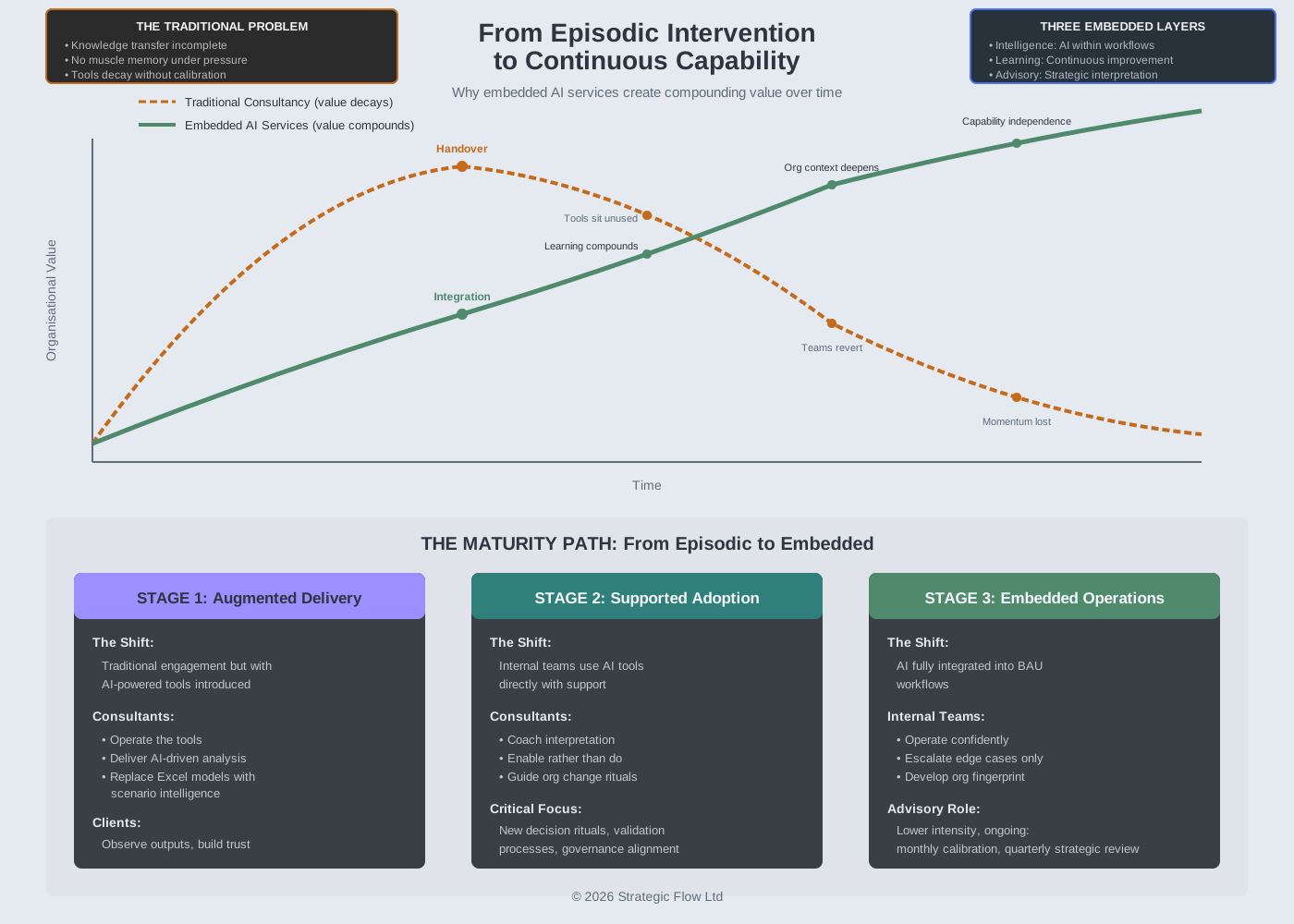
Most consultancy engagements follow a predictable pattern: diagnose the problem, propose solutions, build deliverables, then hand over and exit – often not sticking around to ensure the solution works, to boot. Six months later, the momentum dissipates. Tools sit unused. Insights gather dust. The organisation reverts to familiar patterns, and leaders wonder why the transformation didn’t stick. Embedded AI services offer a fundamentally different model – one that transforms episodic interventions into continuous organisational capability.
The structural problem with traditional consultancy
Traditional consultancy operates on a project-based model (that really exists to sell consultancy bums on seats, not help clients, but we’ll cover that in another post) that creates inherent misalignment. Consultants arrive with deep expertise, analyse complex problems, and deliver recommendations or implementations. Yet the moment they leave, several friction points emerge simultaneously.
First, knowledge transfer remains incomplete. Documentation captures explicit knowledge whilst tacit understanding, the nuanced judgement developed through hundreds of similar situations, walks out the door. Second, the organisation lacks the muscle memory to maintain new practices under operational pressure. When crises hit, teams revert to familiar behaviours rather than newly adopted methods. Third, the tools or frameworks delivered often require ongoing calibration that internal teams struggle to provide without specialist expertise.
In capital markets and financial services more broadly, this pattern manifests acutely. A consultancy might design an elegant workflow optimisation system or risk analytics framework, but without continuous refinement as market conditions shift, these solutions decay rapidly and everyone goes back to their favourite spreadsheet. The initial value delivered is real, yet the trajectory points downward from day one post-engagement.
The underlying issue isn’t consultant quality or client commitment. It’s a structural mismatch between how organisations learn and how traditional consultancy is packaged and sold.
What embedded AI services actually mean
Embedded AI represents a category shift beyond traditional software-as-a-service or managed services. Rather than delivering standalone tools or finite projects, embedded AI services weave intelligent capabilities directly into an organisation’s decision-making fabric, supported by ongoing advisory that evolves with context.
Consider three layers that define truly embedded AI services:
- First, the intelligence layer: AI-powered tools that provide analysis, recommendations, or automation within existing workflows. These aren’t separate applications requiring context-switching, but capabilities that surface insights precisely when decisions are made.
- Second, the learning layer: systems that improve continuously based on organisational feedback, domain-specific data, and evolving business context.
- Third, the advisory layer: human expertise that interprets outputs, calibrates models, and connects AI insights to strategic decisions.
This combination creates something consultancies have historically struggled to provide: capability that compounds rather than depletes over time. The AI handles pattern recognition, data synthesis, and scenario analysis at scale. The embedded advisory ensures outputs remain strategically relevant and operationally actionable.
For transformation stakeholders in complex technology sectors, this matters because it addresses the core frustration: valuable work that doesn’t sustain beyond the engagement period. Embedded AI services shift the value curve upward over time rather than front-loading impact then watching it erode.
How embedded AI extends consultancy value
The mechanics of embedding AI into organisational DNA require deliberate design choices that diverge from traditional delivery models. Rather than building towards a handover milestone, embedded approaches build towards operational independence supported by intelligent augmentation.
Start with the integration architecture. Embedded AI tools must connect to the systems where work actually happens: portfolio management platforms, delivery tracking tools, and strategic planning applications. A standalone analytics dashboard that requires manual data export represents the old model. An AI co-pilot that surfaces Cost of Delay analysis within the prioritisation tool where trade-offs are debated represents the embedded model.
The difference determines adoption. Leaders don’t change behaviour to access insights; insights arrive within existing behaviour patterns. This reduces friction dramatically whilst increasing the frequency of AI-informed decisions. In EV charging infrastructure planning, for example, an embedded AI service might analyse site performance data, regulatory changes, and demand forecasts to flag deployment sequence adjustments – surfaced directly in the capital allocation workflow, not in a separate reporting tool.
Next, consider the learning architecture. Traditional consulting deliverables are static. Embedded AI services improve through exposure to organisational decisions and outcomes. When a recommendation is accepted or rejected, when forecasts prove accurate or miss the mark, when certain scenarios prove more relevant than others – all become training signals. The system develops organisational context that generic tools cannot replicate.
This creates a compounding knowledge advantage. After twelve months, the embedded AI understands company-specific patterns, terminology, risk preferences, and strategic priorities in ways that dramatically increase relevance. This isn’t simply customisation; it’s continuous co-evolution between human judgement and machine intelligence.
Finally, the advisory layer provides the interpretive bridge. AI outputs require contextualisation: what does this pattern mean for our strategy? How should we weight this signal against others? What actions follow from this insight? Embedded advisory doesn’t deliver the analysis then disappear. It maintains an ongoing dialogue that helps leaders develop their own capability to work effectively with AI-augmented decision-making.
From episodic intervention to continuous capability
The transformation from project-based consultancy to embedded capability follows a deliberate maturity path. Organisations don’t typically leap from traditional engagements to fully embedded AI services; they evolve through stages as trust builds and value becomes evident.
Stage One: Augmented Delivery
The consultancy engagement proceeds conventionally – diagnosing problems, designing solutions – but introduces AI-powered tools as part of the delivery. Rather than Excel-based prioritisation models, introduce AI-driven scenario analysis. Rather than manual status reporting, introduce natural language processing that synthesises delivery confidence signals. At this stage, consultants operate the tools whilst clients observe outputs and begin trusting the intelligence layer.
Stage Two: Supported Adoption
As the engagement progresses, internal teams begin using AI tools directly with consultancy support. The advisory shifts from doing the analysis to coaching teams on interpretation and application. Here, organisational change becomes central. Teams need new rituals: how do we incorporate AI insights into governance meetings? What triggers recalibration? How do we challenge or validate recommendations? The consultancy role evolves from expert-doer to expert-enabler.
Stage Three: Embedded Operations
The AI services integrate fully into business-as-usual workflows. Internal teams operate confidently, escalating only edge cases or strategic recalibrations to advisory support. The consultancy relationship becomes ongoing but lower-intensity: monthly calibration sessions, quarterly strategic reviews, continuous model refinement based on evolving business context. Value delivery continues and often accelerates as organisational fluency grows.
This progression requires different commercial models than traditional time-and-materials or fixed-price projects. Subscription-based advisory with usage-based AI service fees aligns incentives correctly: the consultancy succeeds when the client achieves sustained capability, not merely project completion.
For insurance sector transformation leaders, this model addresses a critical constraint. The complexity of regulatory change, claims pattern evolution, and risk model refinement demands continuous intelligence. Episodic consultancy cannot keep pace. Embedded AI services with ongoing expert interpretation provide the adaptive capability required.
Practical architecture: building to embed
Designing embedded AI services demands architectural choices that differ fundamentally from building standalone consulting deliverables. The difference lies in optimising for long-term organisational learning rather than immediate project closure.
Begin with the data foundation. Embedded AI requires continuous access to operational data flows; not periodic extracts for analysis. This means establishing secure, governed connections to source systems whilst respecting data sovereignty and privacy requirements. In capital markets applications, this might include trade data, market signals, operational metrics, and external indicators. The AI service must ingest these streams automatically, applying domain-specific models to generate insights without manual intervention.
Design the interface layer for workflow integration, not separation. The most powerful embedded AI doesn’t announce itself as a distinct application. It appears as an enhanced capability within existing tools. When a portfolio manager opens a prioritisation view, AI-generated Cost of Delay estimates appear inline. When an infrastructure planner reviews site options, embedded algorithms surface demand forecasts and grid constraint analysis contextually. The interface design principle is invisibility: intelligence arrives precisely when needed, within the tools already mastered.
Structure the feedback mechanisms for continuous learning. Every interaction generates potential training data. When users adjust AI recommendations, mark certain outputs as particularly valuable, or ignore others, these signals inform model refinement. The architecture must capture, anonymise where appropriate, and incorporate this feedback systematically. Over time, the embedded AI develops an organisational fingerprint – understanding the specific context, constraints, and preferences that shape decisions in this particular enterprise.
Establish the advisory cadence to maintain strategic alignment. Embedded AI services shouldn’t operate autonomously without human oversight. Regular calibration sessions ensure models remain aligned with evolving strategy, that outputs continue addressing real decision-making needs, and that new capabilities are introduced as organisational maturity grows. Monthly review sessions examining model performance, quarterly strategic recalibrations, and annual deep-dive assessments create a rhythm that sustains relevance.
For data centre operators navigating rapid capacity planning decisions, this architecture enables something previously impossible: real-time optimisation incorporating demand forecasts, energy price signals, infrastructure constraints, and strategic priorities – all validated by expert interpretation that prevents algorithmic drift from business reality.
The organisational change dimension
Technology architecture alone cannot embed AI capabilities successfully. The organisational change dimension determines whether intelligent tools become genuine capability or expensive shelfware. Leaders must design deliberately for the human side of AI adoption.
First, establish new decision-making rituals that incorporate AI insights without deferring judgement to algorithms. The goal isn’t automated decision-making; it’s augmented human judgement. This requires explicit practices: governance meetings that review AI recommendations alongside other inputs, documented processes for when to override algorithmic suggestions, retrospectives examining where AI insights proved valuable or misleading. These rituals build organisational confidence and calibration.
Second, develop interpretive competence within teams. Embedded AI services generate outputs that require skilled interpretation. What does this confidence interval actually mean? How should we weight this scenario analysis? When does correlation suggest causation worth investigating? Building this capability demands ongoing investment in training, coaching, and supported practice. The embedded advisory layer accelerates this learning, but internal competence must grow or dependency replaces capability.
Third, design governance structures appropriate for AI-augmented operations. Who holds accountability when decisions incorporate AI recommendations? How do audit and compliance functions adapt to algorithmic inputs? What transparency and explainability standards apply? Organisations that embed AI services without addressing governance create risk and confusion. Clear frameworks prevent both over-reliance and under-utilisation.
The Theory of Constraints provides useful framing here: organisational change is typically the constraint limiting AI value realisation, not algorithmic capability. Creating outputs at high speed ahead of a bottleneck simply creates more overwhelm for the bottleneck, which translates into more noise in the system. Embedded AI services that address this reality explicitly, incorporating change methodology, leadership coaching, and competence development alongside technical deployment, achieve fundamentally different outcomes than pure technology implementations.
Practical next steps
Leaders considering embedded AI services should progress deliberately through these foundational steps:
Assess current engagement patterns
Map where consultancy value decays post-engagement and why. Identify the capabilities you wish had persisted beyond project completion. These represent prime candidates for embedded AI transformation.
Select a bounded domain
Begin with a specific decision domain – portfolio prioritisation, resource allocation, risk assessment – rather than attempting enterprise-wide embedding initially. Prove the model’s effectiveness in a contained context before expanding.
Design for learning, not just delivery
Structure the initial engagement to build embedded capabilities from day one. Include data integration architecture, workflow interface design, feedback mechanisms, and advisory cadence in the foundational scope.
Establish success metrics aligned with continuous value
Move beyond project completion metrics to measure sustained adoption, decision quality improvement over time, and growing organisational competence. Track whether the capability strengthens six and twelve months post-initial deployment.
Invest in interpretive competence
Dedicate resources to developing internal expertise in working with AI-augmented decision-making. This isn’t IT training; it’s strategic capability development for leaders who must integrate algorithmic insights with contextual judgement.
Conclusion
The shift from episodic consultancy interventions to embedded AI services represents more than incremental improvement in delivery models. It addresses the fundamental misalignment between how organisations learn and how traditional consulting engagements are structured. By weaving intelligent capabilities directly into decision-making workflows, supporting them with ongoing expert interpretation, and designing for continuous improvement rather than static handover, embedded AI services create value trajectories that strengthen over time.
For senior leaders navigating complex transformation in capital markets, infrastructure, insurance, and other technology-intensive sectors, this model offers something conventional consultancy cannot: capabilities that compound rather than decay, intelligence that learns your organisational context, and advisory that evolves with your strategic needs. The question isn’t whether AI will transform how organisations work with external expertise, but whether you’ll shape that transformation deliberately or respond to it reactively.
If you’re exploring how embedded AI services could transform episodic consultancy value into sustained organisational capability, Strategic Flow would welcome a conversation about your specific transformation context and decision-making challenges.