(or any transformation for that matter!)
Key Takeaways
- Green-tech leaders face challenges in transformation due to unclear visibility between strategy and execution.
- Wardley Mapping helps identify where to build or buy capabilities, revealing competitive dynamics and potential commoditisation.
- The mapping process clarifies user needs and necessary components, ensuring strategic alignment and informed investment decisions.
- Integrating Wardley Mapping with Flow and Cost of Delay improves transformation sequencing and delivery confidence.
- Leaders should start with a specific initiative, map current capabilities, and anticipate future needs to drive effective green-tech transformation.
Most green-tech leaders know where they want to go: net zero, market leadership, regulatory compliance. Yet when transformation stalls, it’s rarely because the destination was unclear. The real friction emerges when organisations can’t see the terrain between strategy and execution: which capabilities must be built versus bought, where competitors are moving, and which technology bets will become commodities before delivering returns.
The strategic visibility gap in Green technology
Green-tech transformation presents a unique strategic challenge. Unlike purely digital transformations, leaders must navigate physical infrastructure constraints, evolving regulatory frameworks, and capital allocation decisions with decades-long consequences. An EV charging operator building out network infrastructure cannot simply pivot when technology shifts. A data centre operator committing to renewable energy integration faces irreversible architectural choices.
Traditional strategic planning assumes relatively stable competitive landscapes. But green technology operates at the intersection of policy acceleration, technological maturation, and shifting customer expectations. Battery chemistry advances monthly. Grid integration standards evolve across jurisdictions. Capital markets reward different sustainability metrics each quarter. This creates what strategists call “environmental turbulence” – a state where past performance offers limited guidance for future decisions.
The consequence? Leadership teams make transformation choices with incomplete information about competitive positioning. They invest in capabilities that competitors are already commoditising. They build proprietary systems for components that will be standardised within 18 months. They outsource strategic differentiators because they look like “IT projects”. Wardley Mapping addresses this visibility gap by making the competitive landscape legible.
What Wardley Mapping reveals that traditional strategy misses
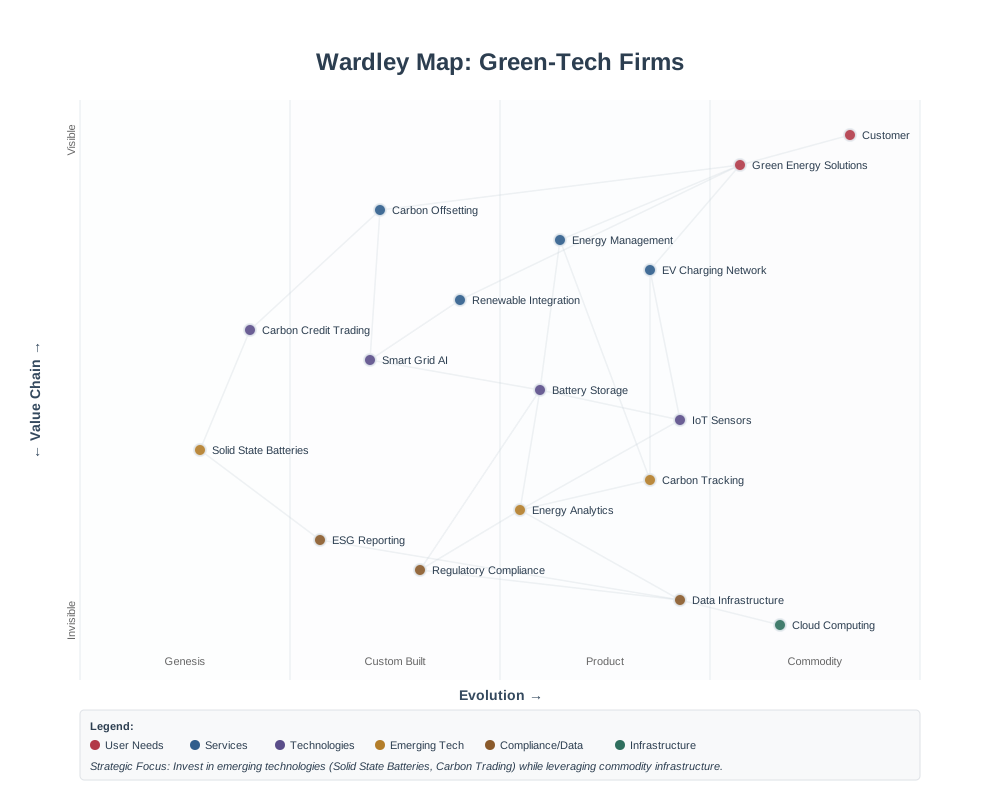
Wardley Mapping, developed by Simon Wardley, visualises strategy as a value chain positioned against an evolution axis. Unlike traditional strategic frameworks that treat capabilities as static assets, Wardley Mapping shows how every component in your value chain evolves from genesis (novel and uncertain) through custom-‘built and product stages, ultimately reaching commodity (standardised and ubiquitous).
For green-tech organisations, this evolutionary perspective surfaces three critical insights. First, it reveals where you’re building custom solutions for problems that now have product-stage answers. A financial services firm building bespoke carbon accounting systems in 2025 is solving a problem that multiple vendors now address at product maturity; thus, capital would deliver better returns elsewhere. Second, it shows which of your current differentiators will become commodities, allowing you to time capability transitions. The EV charging operator investing heavily in proprietary payment systems may find those capabilities commoditised by open banking standards within 24 months. Third, it illuminates where genuine strategic advantage lies… typically in the integration layers between commodity infrastructure and customer-facing innovation.
The mapping process itself forces clarity. Teams must explicitly define what their users need, map the components required to meet those needs, and position each component on the evolution axis. This exercise consistently surfaces assumptions that evaporate under scrutiny. “We need a custom data platform” often becomes “we need commodity cloud storage with a custom analytics layer”. These distinctions determine whether transformation budgets deliver competitive advantage or merely replicate what competitors buy off-the-shelf.
Building your first Green-tech Wardley Map
Start with user needs, not capabilities. For an insurance provider developing climate risk products, the user need might be “accurately price flood risk for commercial property”. For a data centre operator, it might be “demonstrate 24/7 carbon-free energy to hyperscale customers”. Define this need clearly. It anchors everything related to it on the map.
Next, identify the value chain components required to meet that need. Work backwards from the user need, asking “what capabilities must exist for this to work?” An insurance climate risk product requires weather data, property databases, risk models, pricing algorithms, policy administration systems, and regulatory reporting. Each becomes a component on your map. Be specific – “risk models” is too vague, whilst “flood inundation models calibrated to 2050 climate scenarios” defines what you actually need.
Now position each component on the evolution axis. Genesis components are novel and poorly understood, perhaps a new climate scenario modelling approach you’re developing with a university research partner. Custom-built components are understood but not yet standardised – your proprietary integration between climate models and underwriting systems. Product components are available from multiple vendors with defined feature sets – weather data APIs from established providers. Commodity components are ubiquitous and standardised – cloud compute infrastructure, SQL databases, standard policy admin systems.
This positioning determines your strategic choices. Components in genesis or custom-built stages may justify internal investment if they’re differentiators. Components at product or commodity stages almost never justify building. Your capital delivers better returns accelerating differentiation elsewhere. A Wardley Map makes these trade-offs visible to the entire leadership team, transforming abstract strategy debates into concrete capability decisions.
Mapping competitive movement and transformation timing
The real power emerges when you map competitive positioning and evolutionary movement. Plot where competitors have positioned their capabilities. That EV charging network investing heavily in proprietary hardware whilst you’re adopting an asset-light model? Their map shows custom-built charging units; yours shows commodity hardware with differentiation in network orchestration software. These differing positions create different strategic vulnerabilities and opportunities.
More importantly, components evolve. Today’s genesis innovation becomes tomorrow’s commodity. Wardley Mapping reveals this movement through “climatic patterns”, predictable evolutionary forces that shape all technology markets. Successful products attract competition, driving standardisation. Standardisation enables commoditisation. These patterns let you anticipate transformation timing. If your differentiated capability sits at late product stage, competitors will likely commoditise it within 12-24 months so plan your next source of advantage now, not when margin pressure appears.
Consider a capital markets firm building climate risk analytics. Three years ago, Scope 3 emissions calculation required custom-built solutions – genesis territory demanding internal data science teams and proprietary methodologies. Today, multiple vendors offer product-stage solutions with robust feature sets. Within 18 months, basic Scope 3 calculation will almost certainly reach commodity status, embedded in standard reporting platforms. The Wardley Map shows this evolution, prompting strategic questions: Should we continue building our custom solution? Should we acquire product-stage capability and differentiate through integration? Where will advantage shift when Scope 3 becomes commodity? Perhaps to forward-looking scenario analysis or portfolio-level transition planning?
Integrating Wardley Mapping with Flow and Cost of Delay
Wardley Mapping identifies strategic positioning; Flow principles and Cost of Delay (CD3) determine transformation sequencing. Once your map shows which capabilities to build, buy, or partner for, Flow analytics reveals how to sequence that transformation work. Cost of Delay – the economic impact of delaying work – quantifies which capability gaps destroy most value through waiting.
Map your current state Wardley Map against your target state map. The gaps represent your transformation backlog. Now apply CD3 to prioritise: which gaps, if filled today, unlock the most value? Which gaps, left unfilled, incur the highest ongoing costs? An insurance provider’s map might show five capability gaps between current and target states for climate risk products. CD3 analysis reveals that the weather data integration gap costs £50k per week in delayed product launch, whilst the regulatory reporting gap costs £5k per week. Sequence accordingly: address the weather data integration first, even if the reporting gap feels more urgent politically.
This integration between strategy (Wardley Mapping) and execution (Flow and CD3) creates what Strategic Flow calls “Delivery Confidence” – the ability to deliver strategy reliably, at speed, with measurable value. Maps without execution frameworks remain static documents. Execution frameworks without strategic context optimise the wrong work. Together, they transform how leadership teams navigate green-tech transformation.
Explore our Wardley Mapping consulting capability
Practical next steps: mapping your Green-tech position
Start with a single strategic initiative, not your entire organisation. Choose a transformation that matters – perhaps your route to net zero operations, your new climate risk product line, or your renewable energy integration programme. Define the user need clearly and involve people who understand both strategy and operations.
Schedule a two-hour mapping session with 6-8 people from across the value chain: strategy, operations, technology, commercial. Use a large whiteboard or digital collaboration tool. Draw the evolution axis horizontally (genesis, custom, product, commodity) and position user needs at the top. Work backwards to identify components, then position them honestly based on current market maturity, not where you wish they were.
Look for surprises: components you’re building that already exist as products, components you’re buying that should be differentiators, dependencies on genesis-stage technology that threaten delivery confidence. These gaps between current positioning and strategic intent define your transformation priorities. Finally, sketch movement: where will each component be in 12 months? Which competitive forces accelerate evolution? What new user needs will emerge? This forward-looking view transforms the map from analysis into strategic foresight.
Conclusion
Green-tech transformation demands more than ambitious targets and committed capital. It requires visibility into competitive positioning, technological evolution, and strategic sequencing. Wardley Mapping provides that visibility, making explicit the capability choices that determine whether transformation delivers genuine advantage or merely replicates commodity capabilities at custom-built cost. When integrated with Flow principles and Cost of Delay economics, mapping transforms abstract strategy into confident execution.
Strategic Flow would welcome a conversation if you’re exploring how Wardley Mapping can illuminate your green-tech transformation priorities and surface the capabilities that truly differentiate your competitive position.
See also: Diversity and inclusion in transformation: why It matters