Key Takeaways
- Many organisations struggle with the gap between ambition and execution due to a lack of delivery confidence.
- Traditional strategic planning fails because it separates strategy from execution, creating inefficiencies and misalignment.
- Integrating constraint awareness and quantifying the Cost of Delay can enhance prioritisation and improve delivery outcomes.
- Establishing closed-loop feedback between strategy and execution helps organisations respond to challenges in real-time.
- Strategic Flow aims to bridge the divide by aligning organisational structure and delivery methods around strategic initiatives.
Your leadership team has invested months in strategic planning workshops, crafted elegant OKRs, and cascaded priorities across the organisation. Yet six months later, delivery remains unpredictable, strategic initiatives stall, and the gap between ambition and execution feels wider than ever. The problem isn’t your strategy, it’s the absence of delivery confidence.
The hidden fracture between strategy and execution
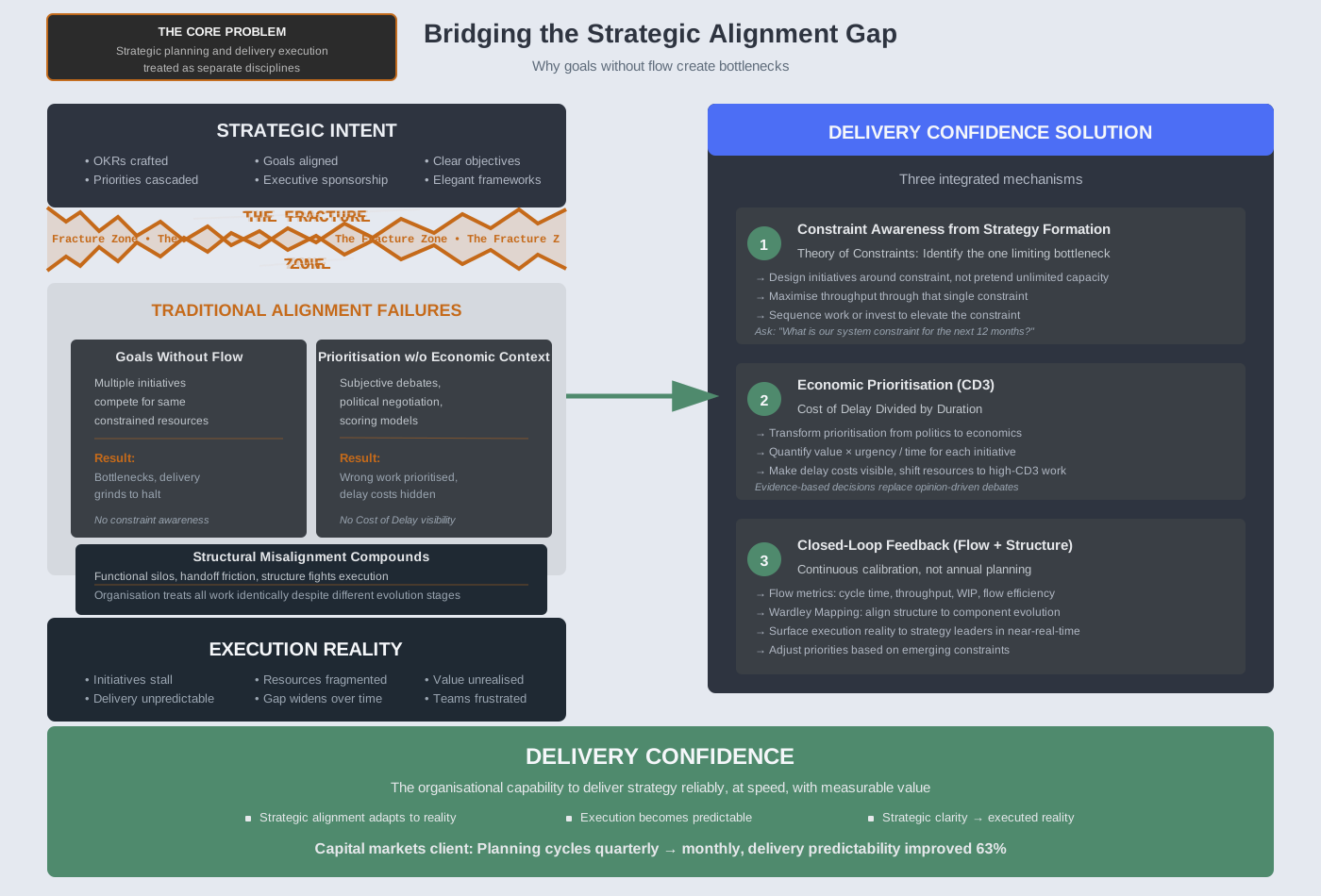
Most organisations treat strategic planning and delivery execution as separate disciplines. Strategy happens in boardrooms with frameworks like Balanced Scorecard and OKRs. Execution happens in project teams with Gantt charts and status reports. This structural separation creates a fracture that undermines both.
In Capital Markets firms rolling out new trading platforms, this fracture manifests as strategic initiatives that consume resources for years without delivering measurable value. In EV charging infrastructure, it appears as deployment targets that slip quarter after quarter whilst competitors capture prime locations. The pattern is systemic: strategic intent becomes diluted through layers of translation, and execution teams lack visibility into which work truly matters.
Delivery confidence – the organisational capability to deliver strategy reliably, at speed, with measurable value – bridges this gap. Without it, strategic alignment remains theoretical. With it, organisations transform strategic clarity into executed reality.
Why traditional alignment approaches fall short
Goals without Flow create bottlenecks
OKRs and cascaded objectives establish what the organisation should achieve. They rarely address how work actually flows through the system. When multiple strategic initiatives compete for the same constrained resources, traditional goal-setting frameworks offer no mechanism to resolve the conflict.
Consider a financial services firm with ambitious digital transformation OKRs spanning customer experience, regulatory compliance, and operational efficiency. Each objective is valid. Each has executive sponsorship. Yet when all three initiatives converge on the same infrastructure team, delivery grinds to a halt. The strategic goals remain perfectly aligned on paper whilst execution fragments in practice.
Flow methodology – which emphasises Work in Progress (WIP) limits and constraint management – reveals what goal frameworks obscure: the system’s actual capacity to deliver. Strategic alignment without delivery confidence is strategy without constraint awareness.
Prioritisation without economic context misleads
Most prioritisation debates rely on subjective judgement or simplified scoring models. Leaders assess strategic importance through discussion and consensus, often weighted by whoever argues most forcefully. This approach conceals the economic impact of choosing one initiative over another.
Cost of Delay (CD3), the economic impact of delaying work, transforms prioritisation from political negotiation to economic calculation. In EV charging infrastructure, deploying assets in high-traffic locations six months earlier can capture market share worth millions before competitors establish presence. Yet without quantifying this delay cost, organisations treat all strategic priorities as equally urgent.
When an insurance firm quantified Cost of Delay across its transformation portfolio, leaders discovered that three initiatives previously ranked as medium priority would collectively deliver more value in the next twelve months than the two flagged as strategic imperatives. This economic visibility shifted resource allocation immediately, accelerating time-to-value without requiring additional investment.
Structural misalignment compounds over time
Even well-designed strategies fail when organisational structure fights against execution. Many enterprises operate with functional silos that were fit-for-purpose decades ago but now introduce friction at every handoff point. Others struggle to implement frameworks, getting confused as to which strategic frame work works (e.g. OKRs, 4DX, or EOS) and become “change fatigued.”
Wardley Mapping, a strategic framework that visualises the evolution of components in your value chain, exposes these structural mismatches. A data centre operator used Wardley Mapping to reveal that its organisational structure treated commodity infrastructure components as if they required bespoke engineering attention, whilst genuinely differentiating capabilities sat in understaffed teams. This misalignment between component evolution and organisational design created systemic delays that no amount of strategic goal-setting could overcome.
Fit-for-Purpose organisational design acknowledges that different types of work require different structures. Genesis innovation demands experimentation and autonomy. Industrialised operations require standardisation and efficiency. Strategic alignment fails when the organisational model treats all work identically.
Building delivery confidence into strategic alignment
Integrate constraint awareness from strategy formation
Theory of Constraints teaches that every system has exactly one constraint that limits throughput at any moment. Strategic planning should explicitly identify this constraint and design initiatives around it rather than pretending unlimited capacity exists.
During strategic planning cycles, ask: “What is our system constraint for the next twelve months?” For many capital markets firms, the constraint is specialist technical talent in trading systems. For EV charging operators, it’s often site acquisition and grid connection timelines. For insurance companies, it may be regulatory approval cycles.
Once identified, strategic alignment means designing your initiative portfolio to maximise throughput through that constraint. This might mean sequencing work differently, investing to elevate the constraint, or deliberately saying no to initiatives that would overwhelm it. Strategic alignment without constraint awareness produces elegant plans that reality immediately defeats.
See also our article: Build delivery confidence even as strategic priorities shift
Quantify economic impact across your portfolio
Move beyond subjective prioritisation by quantifying Cost of Delay for strategic initiatives. This requires two inputs: the value the initiative will deliver once complete and the duration required to deliver it. If you like, you can also add a third: how urgently that value is needed.
Express this as CD3: Cost of Delay Divided by Duration. Initiatives with high CD3 scores deliver disproportionate value relative to the time invested. Those with low scores consume resources without proportional return so you want to avoid (or, at least, defer) them. This economic lens transforms portfolio conversations from opinion-driven debates to evidence-based decisions.
A financial services firm applying CD3 across its transformation portfolio discovered that accelerating two regulatory compliance initiatives would free capacity to deliver four customer-facing innovations within the same fiscal year. The economic case was unambiguous once delay costs became visible. Strategic alignment shifted from accommodating every stakeholder request to maximising portfolio-level value delivery.
Establish closed-loop feedback between strategy and execution
Strategic alignment requires continuous calibration, not annual planning cycles. Organisations with delivery confidence establish feedback loops that surface execution reality to strategy leaders in near-real-time.
Flow metrics – cycle time, throughput, WIP, and flow efficiency – provide this feedback. When strategic initiatives consistently exceed planned cycle times, the signal is clear: either the strategy underestimated complexity, or systemic constraints need addressing. When throughput drops despite adding resources, you’ve likely introduced too much WIP and overwhelmed the system.
An EV charging infrastructure operator implemented fortnightly Flow reviews where strategic leaders examined delivery metrics alongside business outcomes. When deployment cycle times increased by 40% over two quarters, investigation revealed that site acquisition had become the binding constraint. Strategic priorities shifted immediately to address this, restoring delivery confidence before the annual plan even came up for review.
The Strategic Flow approach to alignment and delivery
Strategic Flow operates at the intersection of business strategy, delivery excellence, and decision intelligence. Our approach integrates strategic alignment frameworks like OKRs and Balanced Scorecard with delivery acceleration methods including Flow, Theory of Constraints, and CD3 prioritisation.
This integration creates delivery confidence through three mechanisms. First, Wardley Mapping and Fit-for-Purpose design ensure organisational structure aligns with the evolutionary stage of work being delivered. Second, Flow analytics and constraint management optimise how work moves through the system. Third, CD3 economic prioritisation ensures the right work receives focus at the right time.
For a capital markets client, this approach compressed strategic planning cycles from quarterly to monthly whilst improving delivery predictability by 63%. The key was establishing closed-loop feedback between strategic intent and execution reality, allowing leaders to adjust priorities based on emerging constraints rather than waiting for formal planning windows.
The result is strategic alignment that adapts to reality rather than assuming perfect foresight. Delivery confidence becomes the foundation for strategic agility, not an afterthought once plans are set.
Practical next steps for leaders
Identify your system constraint
Examine your current strategic portfolio and determine which single bottleneck limits overall throughput. Design your next planning cycle around maximising flow through that constraint.
Quantify Cost of Delay
For your top ten strategic initiatives, calculate CD3 scores using estimated value delivery, duration, and urgency. Reprioritise based on economic impact rather than subjective importance.
Establish Flow metrics visibility
Implement cycle time, throughput, and WIP tracking for strategic initiatives. Create a monthly review where strategy leaders examine these metrics alongside business outcomes to surface misalignment early.
Map your value chain evolution
Use Wardley Mapping to assess whether your organisational structure matches the evolutionary stage of components in your value chain. Identify structural mismatches that create friction.
Conclusion
Strategic alignment without delivery confidence produces plans that look compelling in presentations but fracture under execution pressure. The gap between strategic intent and delivered value isn’t a failure of ambition, it’s a structural problem requiring systemic solutions.
By integrating constraint awareness, economic prioritisation, and closed-loop feedback between strategy and execution, organisations build delivery confidence that transforms strategic clarity into measurable outcomes. The frameworks exist. The question is whether your organisation will continue treating strategy and delivery as separate disciplines, or recognise that strategic alignment only matters when it produces delivered value.
If you’re exploring how to build delivery confidence into your strategic alignment processes, Strategic Flow would welcome a conversation about applying Flow analytics, CD3 prioritisation, and Wardley Mapping to surface the systemic constraints limiting your strategic execution.