
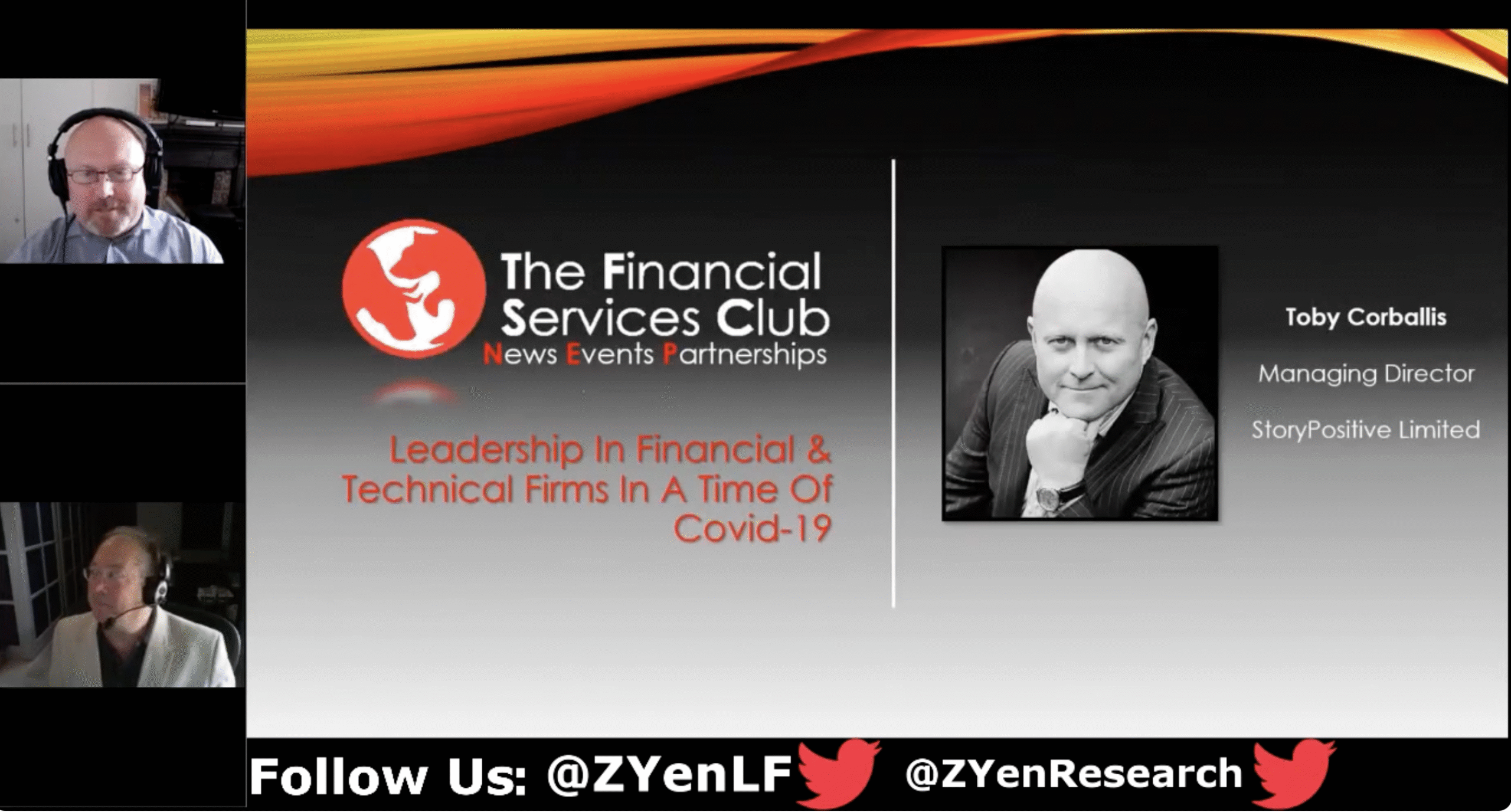
Financial Services Club, City of London
In this video, Toby presents to members of the prestigious Financial Services Club, in London, run by Z/Yen. In this webinar, Toby takes another look at the tools that can help leaders of Financial and Technical firms lead their organisations during, and post, the Covid-19 pandemic. Despite being presented during Covid, the methods and tools evaluated are as relevant now, in times of AI, global security uncertainty, and in the face of ever-evolving technological advancements. Change in a changing world can be frustratingly difficult but, here, Toby seeks to clarify some of the concepts around connecting strategy to execution and using Systems Thinking to ensure success when implementing change.
Full transcript
Leadership in extraordinary times
Introduction
Michael Mainelli:
Good day, everyone, and welcome to another FS Club seminar. Today we are joined by a dear friend of mine, Toby Corballis, who will be speaking about leadership in financial and technical firms during the COVID-19 pandemic. I hope he will explain COVID-19 at some point; apparently, it is some sort of pandemic that is doing the rounds.
For those of you who do not know me, I am Michael Mainelli, Chairman of the Z/Yen Group. It is a privilege to host these webinars at a time when so many are tuning in. We have nearly 40 people on the line already, and more will be joining.
Before we begin, I want to thank our sponsors. Without them, we simply would not be able to do this work. What I value most is that they allow us to range widely and freely, without editorial interference, across a whole variety of subjects.
Many of our sponsors are technology or financial services firms, which makes today’s topic especially relevant. Leaders everywhere are discovering what leadership truly means in such difficult times. One of my favourite short poems on leadership goes:
I want to be the leader.
I want to be the leader.
Let me be the leader.
Let me be the leader.
I’m the leader; yippee!
I’m the leader…
Now what do we want to do?
A lot of people are realising that they are “the leader” and are only now beginning to see what that really means.
Toby will speak for about 25 minutes, followed by 15 to 20 minutes of questions. Please use the GoToWebinar facility to submit questions. If we run out of time, we will forward them to Toby for a direct response. If you would like an introduction to Toby, simply note that in your question and I will arrange it.
My job now is to get out of the way and let Toby shine. Toby, over to you.
Presentation
Toby Corballis:
Thank you very much, Michael, and greetings, everyone. It is a pleasure to be here, and I am very much looking forward to this session. Please do send questions throughout, and I will answer them at the end.
Let us begin with a quote.
Expectations vs reality
Slide: “The curious incident of the dog in the night-time”
Arthur Conan Doyle’s Silver Blaze contains a short exchange between Sherlock Holmes and a detective from Scotland Yard:
“Is there any other point to which you would wish to draw my attention?”
“To the curious incident of the dog in the night-time.”
“The dog did nothing in the night-time.”
“That was the curious incident.”
Lifted out of its story context, this exchange highlights the difference between expectation and reality. What we expect to happen does not always happen.
Slide: Expectations entering lockdown
Entering the COVID-19 lockdown, leaders shared a range of expectations across technology firms, financial institutions, and firms combining both. Many expected that:
- Systems and networks would not cope.
In reality, systems proved resilient. Some people worked long hours to make this possible, but overall, the technology held up. - Markets would crash dramatically.
Although volatile, we did not see the kinds of “flash crashes” experienced in previous downturns. - Banks would fail.
To date, no major failures have occurred, and banks continue to perform essential functions. - Large funds would see catastrophic runs.
Redemption gates and new fund creation helped maintain stability. - Liquidity would dry up, similar to previous crises.
Liquidity has remained, despite volatility. - People working from home would be unproductive.
Despite challenges, productivity has been surprisingly high.
The final expectation is especially important:
How can leaders lead effectively if they cannot see the people they are leading?
We will return to that.
Current risk environment
Slide: Cyber and operational risk statistics
Since lockdown:
- Cyberattacks on banks are up 238%.
- Ransomware attacks are up 900%.
- Mobile and fixed network usage is up 20% to 40%.
- Attacks are increasing in complexity. Vodafone, for example, reported a breach in May that actually occurred in January.
- 44% of firms used outdated videoconferencing versions.
- 47% allowed staff to purchase their own devices.
- 41% reported that home systems are not GDPR-compliant.
- 33% say they still lack infrastructure for long-term remote working.
These numbers show not only increased threat, but also that operational behaviours have changed faster than governance.
Leadership response
Slide: Response speed
So far:
- 37% of firms have made redundancies in IT.
- 47% have frozen agency budgets.
There is a significant difference between reducing spend responsibly and freezing spend entirely, which prevents firms from addressing rising risks.
Wicked problems
Slide: Wicked vs tame
COVID-19 is a wicked problem. We do not know:
- whether it mutates,
- whether it is cyclical,
- whether immunity is lasting,
- or what happens next.
Horst Rittel and later Richard Buchanan and Keith Grint categorised problems as:
- Tame: Seen before; known solutions exist.
- Wicked: Novel, contextual, cross-boundary, with hidden impacts and no obvious end state.
Keith Grint states that leaders addressing wicked problems must reduce anxiety and facilitate innovation, not attempt to apply a template from a previous problem.
In other words: if you try to use a solution from a different context, you will most likely fail.
The “next normal”
We cannot speak credibly of the “new normal”. We do not yet know the end state. The best we can do is navigate the next normal, constantly changing.
Examples of upcoming challenges:
- Videoconferencing fatigue (“Zoom gloom”).
- Uncertain future of commuting and offices.
- Changes to real estate usage.
- Need for regional offices or distributed team models.
- The emergence of “bring your work to the device”, not “bring your device to work”.
All of this increases the question:
How do you lead when you cannot see the people you lead?
Leading without seeing
Slide: Behaviour, attitude, context
John Galtung’s triangle shows that we never truly see the whole picture of a person, even in-person. Leadership has always involved incomplete visibility. The question is how to lower, or at least not raise, the visibility barrier.
Leading through wicked problems
Key practices:
- Frame problems correctly (tame vs wicked).
- Use the right methodology: tame → waterfall; wicked → agile.
- Continuously redefine desired outcomes.
- Measure outcomes regularly, rather than waiting for project completion.
- Use sense-making (Everett Rogers); not everything can be reduced to data alone.
- Communicate with integrity, combining honesty, empathy, and decency.
A visible Kanban board reveals progress and blockers. It is not merely a project tool, but a transparency and accountability tool. Used properly, it helps identify those who need help, not just those who underperform.
Technology and resilience
A recent Gartner statement reads:
“COVID-19 is a wake-up call for organisations that have placed too much focus on daily operational needs at the expense of investing in digital business and long-term resilience.”
Cloud platforms have adapted faster than traditional systems because they allow instant scaling. Post-2008, many major firms turned to smaller consultancies and startups for innovation. History may repeat.
We must measure value per pound spent, not IT spend as a percentage of revenue.
Risk modelling
We have been lucky. Ebola is deadlier. Measles is more contagious. COVID-19 happened to land in the middle. There is no rule saying the next pandemic must be similar, or that it will be as survivable.
We must model future threats and iterate continuously, not treat this as a one-off.
Conclusion
A popular Einstein anecdote tells of him re-issuing the exact same exam question. When challenged, he replied:
“The questions are the same; the answers are different.”
That is where we are now.
We must:
- Expect change, and not be lulled into false security.
- Use our time wisely.
- Recognise that digitalisation, security, efficiency, and compliance are not going away.
- Classify problems correctly.
- Iterate, measure, and adjust continuously.
- Avoid clinging to outdated methods simply because they are comfortable.
- Above all, act with honesty, integrity, and decency. That is the only way to get it back from those we lead.
Q&A (tidied)
Q: Can you give a 30-second definition of sense-making?
Sense-making is not a science; it is the art of determining what feels appropriate or necessary under current conditions. It requires holding back from rushing to analysis, listening, and forming a grounded judgement before acting.
Q: Can wicked problems simply be bundles of tame problems?
Sometimes, yes. If someone elsewhere has solved the issue, you can “tame” your wicked problem by finding the expert. Some suggest a category of critical or super-critical problems with time pressure.
Q: Can leaders be unconsciously dishonest?
Leaders may withhold information responsibly, which is not dishonesty. They may need to delay disclosure to validate facts or avoid causing unnecessary disruption.
Q: Does transparency, such as Kanban, risk increasing stress?
Yes, if poorly managed. The point is not to expose people, but to identify blockers and support them. Leaders must check how people are coping personally, not just whether tasks are complete.
Q: Will leadership become more collective?
Possibly. The “servant leader” model empowers teams to lead themselves. Leadership is about relationships, not control.
Q: Is COVID-19 a chance to push long-wanted change?
Yes. Digitalisation, security investment, and workplace redesign are areas where leaders can use this moment as a catalyst.
Q: What about poor home-working conditions?
Not everyone has suitable space or infrastructure. Companies may need to support better equipment, create regional hubs, or rotate attendance using models such as “blue team/green team”.
Q: How do leaders encourage resilience without sacrificing efficiency?
Einstein said, “Everything should be made as simple as possible, but no more so.” Leaders must balance efficiency with robustness and continuously reassess. There is no permanent formula; only ongoing evaluation.
Close
Michael Mainelli:
Toby, thank you for a thought-provoking session. You have given us much to consider, particularly around leading when we cannot see the people we lead. Thank you to our sponsors, thank you all for attending, and please join us tomorrow for our session on contact tracing, and on Friday for our webinar on tele-psychiatry and mental health.
Toby, you will have to accept applause without seeing it, so here is mine. Thank you again, and we look forward to welcoming you back.
Toby Corballis:
Thank you very much. My pleasure. See you all soon.