
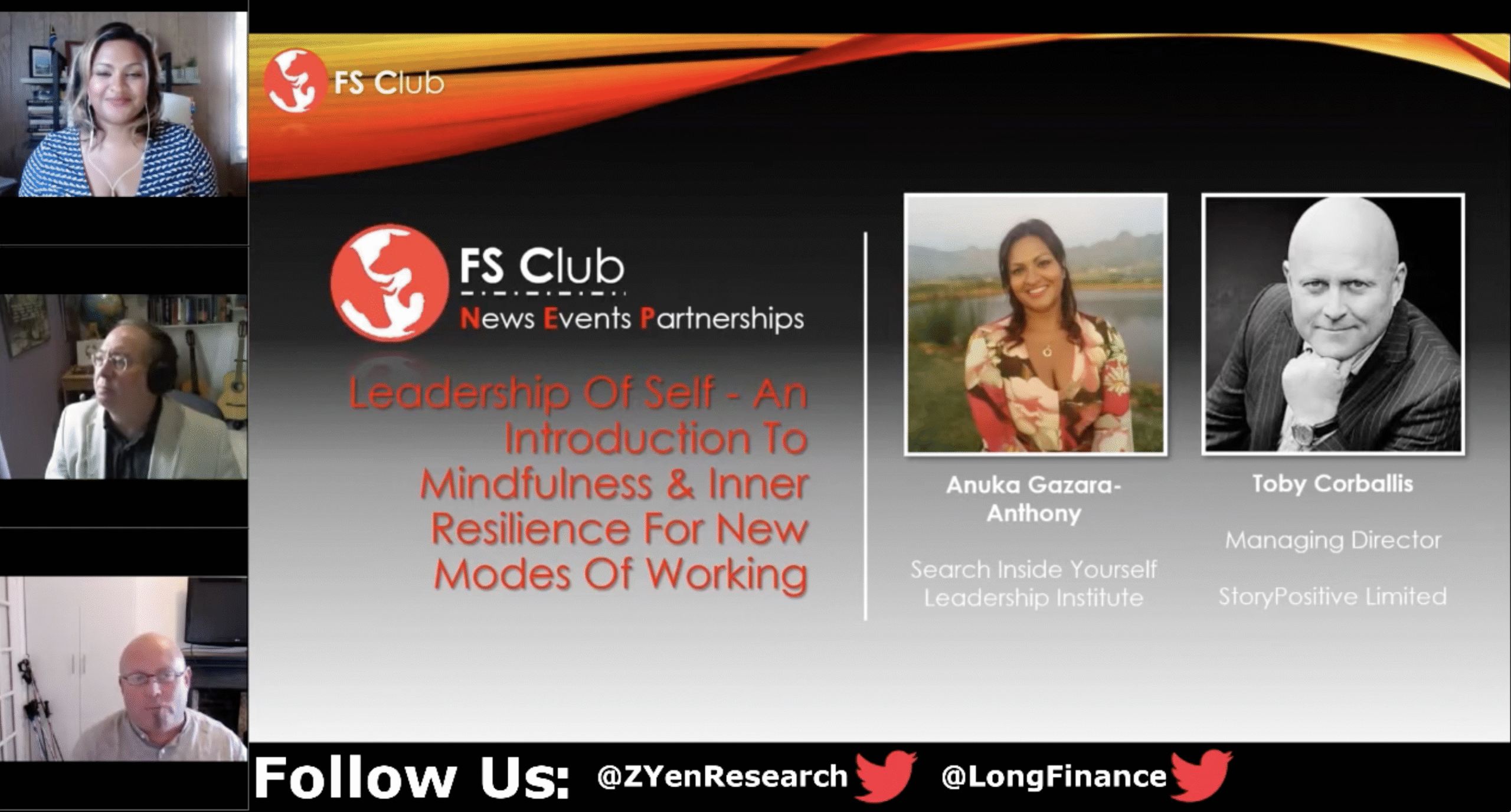
Toby Corballis with Anuka Gazara-Anthony
In this video, Toby and Anuka present “Leadership Of Self – An Introduction To Mindfulness & Inner Resilience For New Modes Of Working”, at the FS Club (Financial Service Club), the number one global networking group for executives in business, technology, and finance, provided by Z/Yen, the City of London’s leading commercial think-tank, founded in 1994 to promote societal advance through better finance and technology.
Anuka Gazara-Anthony works as a mindfulness-based leadership coach who mentors’ executives, entrepreneurs and individuals using the Search Inside Yourself (SIY) method.
Originally created at Google, SIY is an emotional intelligence (EI) program that gives you a practical way to build EI across your teams. SIY gives participants tools to become more resilient, stay focused, and communicate better.
Combined with the Systems Thinking and tools that connect strategic intent to execution, adopting a mindfulness approach can help bolster effectiveness in the workplace.
Full Transcript
FS Club webinar: mindfulness, leadership, and inner resilience
Michael Mainelli:
Good day, everyone, and welcome to this FS Club webinar. Although I would like to say it is taking place in London, it is really happening around me in London, while Toby Corballis is en route to the Netherlands, and Anuka, who joins us today, is leaving Washington DC and heading to South Africa. So we are everywhere and nowhere all at once, which seems like the perfect introduction to leadership itself. Today’s theme is an introduction to mindfulness and inner resilience for new modes of working.
You will all know me. I am Michael Mainelli, one of the Directors of Z/Yen, and it is my privilege to introduce and share many of our FS Club webinars. That is possible thanks to our very tolerant sponsors, who allow us to range widely across technology, economics, and finance.
Mindfulness might appear to sit slightly on the edge of our usual agenda. However, we have held events on this topic before, and they have been extremely well received. In uncertain and often difficult times of change, there is a great deal we can learn from mindfulness practices. Our two guests, Toby and Anuka, will elaborate on this in more detail.
The plan is straightforward. We will hand over shortly to Anuka, who will introduce some ideas and demonstrate a mindfulness technique that participants can follow from home or from their office. We aim to leave 15 to 20 minutes for questions and discussion, as there is plenty to explore.
If you wish to ask a question or make a comment, please do so using the GoToWebinar facility. Emailing me will not help, as I am here with you online. With that, I would like to hand over to Toby.
Toby Corballis:
Thank you, Michael. It is great to have Anuka with us today. If we could move to the next slide, we will frame today’s discussion by looking at the organisation as an entity, the team as an entity, and finally, the individual. There are important similarities and relationships between these levels. We will highlight some of them and, towards the end, Anuka will guide us through a mindfulness technique that you can apply in daily life.
Next slide, please.
My name is Toby Corballis, and I am an organisational change expert. I host the podcast Wicked Problems, and I recently published a book called Digital Leadership Delivered — a somewhat grand title, perhaps, but there we are. I have been involved in five start-ups, two of which failed, and three of which have been successful and continue to be so. My postgraduate qualification is in organisational leadership, I am a qualified Kanban Management Professional, and I once fell off a mountain — about 300 metres. Fortunately, the mountain had the good sense to move out of the way and not injure itself.
That is a quick overview of me. I will hand over to Anuka, and I will be back with you shortly.
Anuka Gazara-Anthony:
Thank you, Toby, and hello everyone. I am very grateful to be here today, and thank you, Michael, for your introduction. My name is Anuka Gazara-Anthony. I am a mindfulness teacher and an emotional intelligence coach. I work with individuals, businesses, and organisations, providing tools to navigate change management and other challenges using emotional intelligence practices. I am currently based in Washington DC.
Before we begin, we will start with a short, mindful poll. We would like to ask you: What percentage of time per day does the average person’s mind wander? We will reveal the answer later in the session.
(Results displayed.)
Thank you for voting. Most of you believe the mind wanders more than 40 per cent of the time, so let us keep that in mind as we move forward.
Why mindfulness matters now
Why are we here? Why is it important to acknowledge that mindfulness and emotional intelligence can help us cultivate resilience in our teams, our work, and our personal lives? I also work with an organisation called Search Inside Yourself – often referred to as SIY – which was developed within Google.
We often hear the term VUCA, which stands for volatile, uncertain, complex, and ambiguous. Interestingly, it was originally a term used by the US Army to describe war-like conditions. Yet these words equally describe modern life. Studies show that navigating such volatility affects our ability to focus and perform.
Let us now explore how these challenges affect leadership and teams.
(Toby)
Thank you, Anuka. I will briefly connect the VUCA world to organisational and team contexts. Organisations exist to solve problems. A useful framework was created by Horst Rittel and Melvin Webber, who classified problems into three types:
Critical problems
These must be solved immediately, without time to plan. For example, during the COVID-19 lockdown, leaders announced that people must work from home. There was no planning time – it had to happen immediately.
Tame problems
We have seen them before, even if they are complex. A tame problem is like constructing a building. It requires expertise, but the steps are known.
Wicked problems
These appear unsolvable. We may never have faced them before, and they often span departments, with hidden impacts and no clear stopping point. They frequently create cognitive dissonance, leading us to fall back on familiar solutions that do not fit.
Next slide, please.
Leadership, management, and imbalance
Leadership is not simply something that can be defined in a sentence. It involves establishing and communicating a vision, seeing both the detail and the wider system, selecting people for skill and potential rather than personality, and acting with honesty, integrity, decency, ethics, and fairness – towards colleagues, clients, competitors, and importantly, ourselves. Too often, we neglect ourselves.
John Kotter describes leadership as sense-making and direction-setting, while management focuses on execution. When leadership is strong but management is weak, innovation may flourish, but chaos follows. When management is strong but leadership is weak, we find well-run bureaucracy that struggles to adapt. We need both.
Next slide, please.
We are all walking a COVID-19 tightrope. The rule seems simple: one person per rope, maintain balance, and do not look down. But everyone looked down at the same time, and no one quite knows how to respond.
Next slide, please.
When systems become imbalanced, variables such as quality, speed, predictability, quantity, and value are disrupted. Ego often exacerbates the issue. Balanced systems flow; imbalanced systems clog and stall.
Next slide, please.
Bruce Tuckman’s model shows that teams progress through forming, storming, norming, performing, and eventually adjourning. The curve of a team’s emotional development closely matches what Anuka will now discuss on an individual level.
(Anuka)
Thank you. To understand change, we must understand emotional awareness and regulation. Elisabeth Kübler-Ross originally described stages of bereavement, later adapted for organisational change. These stages include shock, denial, frustration, fatigue, experimentation, decision-making, and integration.
Not everyone moves through these stages at the same pace. Communication and support can accelerate progress or set people back.
Mary Shelley wrote, “Nothing is so painful to the human mind as a great and sudden change.” Although humans are highly social, change can feel threatening, and our brain reacts accordingly.
The prefrontal cortex, limbic system, and amygdala process threat responses. We perceive change the same way we perceive danger. Simultaneously, we are wired for belonging and connection. Mindfulness helps disrupt automatic threat responses and build new neural pathways.
Next slide, please.
When we are on autopilot, we operate from habit, distraction, and emotional reactivity. Our mind ruminates about the past or worries about the future, but rarely sits in the present.
Victor Frankl, as summarised by Stephen Covey, said: “Between stimulus and response there is a space. In that space is our power to choose our response, and in our response lies our growth and our freedom.” Mindfulness helps us find that space.
The UK Government’s Mindful Nation report defined mindfulness as paying attention to the present moment in the mind, body, and environment with curiosity and kindness. Compassion is anti-inflammatory – research shows that practising compassion reduces inflammation in the body. If you miss a day of exercise or have a difficult conversation, respond the next day with curiosity and kindness, not criticism.
STOP practice demonstration
Anuka Gazzara Anthony:
We are now going to do a short practice called STOP. Before we begin, take a moment to bring to mind something that is causing a little difficulty in your life. On a scale of one to ten, do not choose something at level ten, but something around a five. It should be mildly frustrating or uncomfortable, something that is causing concern, but not something overwhelming. Hold that experience in mind.
First, take a moment to notice your body. Simply become aware of how your body feels where you are sitting.
Now we will move into the observation part of the practice. We will do this by using the breath.
Let us take one deep breath in, and a long breath out.
With your next breath, gently focus on your body. Feel the breath moving within the body as you inhale, and let go as you exhale.
Take another breath in, and as you inhale, notice your feelings. What emotions arise when you think of the experience you brought to mind? Observe them, and then release them on the exhale.
Take a final breath in, and this time, pay attention to your thoughts. What thoughts are present when you consider this experience? Observe them, and exhale to let them go.
Now, allow your awareness to rest on your breath once more. As you do, notice how this experience feels in your body. Where are you feeling it? Can you use that sensation as information to help you decide the next step in responding to this situation?
Continue with gentle breathing for a moment. Notice the body, the breath, and the present moment.
When you are ready, let the experience go, return your attention fully to the breath, and slowly open your eyes. Come back into the room.
Mindfulness after STOP
Anuka:
What you just did is called a three-centre check-in. The first breath brings attention to the body, the second to feelings, and the third to thoughts. If you find yourself in a difficult meeting or in a challenging conversation, this is a micro practice you can use discreetly. It helps you respond wisely rather than react instantly when emotions are heightened.
Poll results discussion
Toby Corballis:
Let us now return to the poll we asked earlier. Research shows that the average mind wanders about 47 per cent of the time. Interestingly, leaders report being unable to stay attentive in meetings about 70 per cent of the time, and only two per cent regularly make time to enhance personal productivity. So, if you guessed 47 per cent, well done, and do not worry if you did not. Many people assume it is higher, and for leaders it often is.
Q&A session
Michael Mainelli:
Thank you very much, both. I am feeling mindfully relaxed, but our audience still has a number of questions.
Audience question (Hugh Purser):
There seem to be similarities between mindfulness and martial arts. Do either of you have martial arts experience?
Toby:
Yes, a little. I practised Shotokan karate, which is full contact, and Krav Maga, an Israeli martial art.
Anuka:
I do not personally, but it makes sense. Many martial arts cultivate presence by focusing attention on how the body moves. Movement-based practices such as tai chi also develop mindfulness.
Audience question (Ian Harris):
A recent report in New Scientist suggested that one in twelve people have negative reactions to mindfulness. Is that true, and what should we watch out for?
Anuka:
Yes, this is an important point. Some people find breath-focused practices triggering, especially during the pandemic, when breathing has become associated with anxiety or trauma. In those cases, instead of focusing on the breath, it is safer to focus on physical sensations, such as the feeling of the feet on the ground, or the contact between the body and the chair. That still supports mindfulness without causing distress.
Audience question (Susan Cuff):
Earlier you said leaders should select for skills and potential, not personality. Surely personality mix matters for a team?
Toby:
Yes, diversity of personality is valuable, but the point is not to select someone simply because they are similar to you. You should not choose people because they are your friends, or because they think in the same way. Talented teams are diverse, but they are chosen for capability and potential, not familiarity.
Audience question (Sue Algeo):
Are good leaders born or made?
Toby:
Some people have innate leadership ability, just as some have innate musical talent. However, leadership is absolutely something that can be taught and practised. People can become leaders through learning.
Anuka:
Neuroplasticity shows us that the brain can change structurally through practice. With emotional intelligence and mindfulness training, leaders can be developed, not only discovered.
Audience question (Paul McDowell):
If routine is the opposite of change, should routines be discouraged?
Anuka:
Routine is helpful when establishing practices such as mindfulness. Consistency builds long-term benefit. However, it should not become rigid.
Toby:
Agreed. Routine is useful, but dogmatic routine is restrictive. In organisational change, do not assume that because something worked once, it will work everywhere. Be willing to adapt.
Audience question (Bob):
How important is physical interaction? Does remote working affect the process of change?
Toby:
There is tremendous value in physical interaction because of non-verbal communication. Online communication is useful, but it cannot replace all in-person cues.
Anuka:
Human beings are wired for connection. Physical presence supports emotional wellbeing. Even socially distanced connection matters.
Audience question (Donald McRae):
Teams are often unbalanced. How should we deal with that? Should people be taught new behaviours, or should we change the team?
Toby:
Changing the team should be a last resort. First, help people understand their current behaviours and how those behaviours affect the team. Simulations can help people experience the impact of their behaviour in a safe space, and this often leads to behavioural change.
Audience observation (Sue Algeo):
Mary Shelley said sudden change is painful, but sometimes extreme change is stimulating and creative.
Anuka:
That is true. Some people embrace change easily, but many are simultaneously dealing with multiple uncertainties. For those individuals, sudden change can be exhausting. Mindfulness helps people adapt in alignment with their values.
Toby:
In change management models such as Kotter’s, a small group embraces change immediately, another group resists, and most are somewhere between. We must support all of them.
Session close
Michael Mainelli:
We have run out of time. This has been a fascinating discussion. I suspect we will see more research into how mindfulness works, particularly in groups. For now, thank you to our speakers, Toby and Anuka, and to our FS Club sponsors.