Key Takeaways
- Most sensible strategies fail due to competition from existing commitments and pressures, not a lack of clarity.
- Alignment efforts are temporary and often break down under pressure, leading to reinterpretation and parallel priorities.
- Overload distorts decision-making, making it harder to execute strategies effectively.
- Systems shape behaviour more than intent; poor system design leads to strategy degradation over time.
- Execution improves when organisations constrain priorities, make trade-offs explicit, and gain clarity on limiting factors.
The real problem of strategy
Most failed strategies are not foolish, naive, or poorly intentioned. They are sensible.
Leadership teams define clear goals, commission robust analysis, and make decisions they believe to be sound. Yet months later, outcomes lag expectations. Progress feels slower than planned. Confidence erodes.
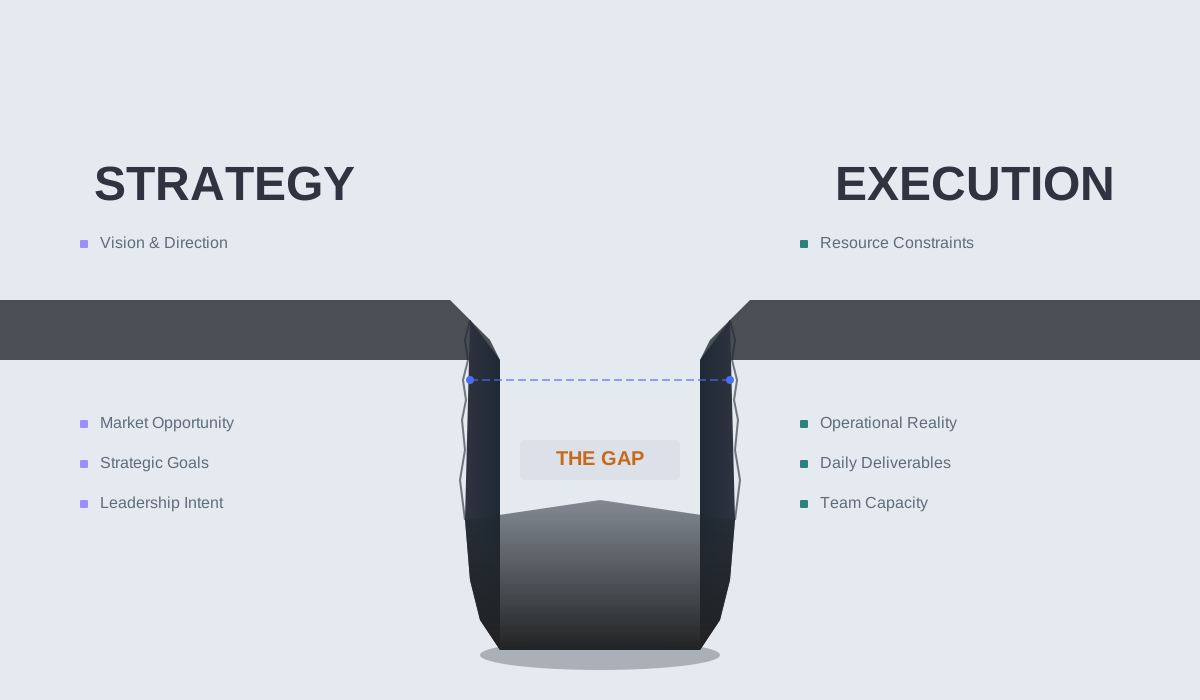
This is not because leaders lack clarity. It is because clarity alone does not survive contact with the system.
This is why even the most sensible strategies fail to produce outcomes expected.
Strategy usually fails after it is agreed
In many organisations, the hardest part of strategy work is not deciding what matters.
It is ensuring that decision continues to matter when:
New opportunities appear
Pressure increases
Deadlines loom
Exceptions feel justified
As strategy moves into the organisation, it competes with:
Existing commitments
Local incentives
Unfinished work
Legacy priorities
Nothing explicitly contradicts the strategy.
It is simply crowded out.
Alignment decays under pressure
Most organisations attempt to solve this through alignment:
- Cascading objectives
- Town halls and communications
- Scorecards and dashboards
These help, but only briefly.
The thing is, alignment relies on continued agreement and goodwill. Under pressure, it gives way to:
- Reinterpretation
- Workarounds
- Parallel priorities
Without constraint, alignment is temporary.
Overload distorts decision-making
The most consistent predictor of poor execution is not capability or commitment.
It is overload.
When too much work is in motion:
- Decision quality declines
- Trade-offs are avoided
- Everything feels urgent
- Progress slows across the board
Execution problems are often framed as delivery failures.
In reality, they are decision failures caused by excess demand.
Systems shape behaviour more than intent
People respond rationally to the systems they operate within.
If the system:
- Makes it easy to start work
- Makes it hard to stop work
- Rewards activity over outcomes
- Separates decisions from consequences
Then even the clearest strategy will degrade over time.
This is not a cultural issue.
It is a design issue.
Frameworks don’t fix this by themselves
Frameworks can help surface problems.
They rarely fix them on their own.
Used well, frameworks:
Provide shared language
Highlight trade-offs
Enable better conversations
Used poorly, they:
Create compliance rituals
Add reporting overhead
Obscure underlying constraints
The critical question is not which framework to adopt, but what mechanism will reliably hold strategic intent in place.
Execution improves when priorities are constrained
Strategies begin to produce outcomes when organisations introduce mechanisms that:
Limit how much work can be in process at any one time
Make trade-offs explicit and unavoidable
Connect strategy to funding and sequencing
Surface drift early, not retrospectively
These mechanisms vary by context.
What matters is not the label, but the effect:
Strategic intent continues to shape decisions when conditions change
Toby Corballis, Founder – Strategic Flow
Clarity must precede change
Many organisations respond to poor outcomes by launching transformation initiatives.
This often adds movement without progress.
Before changing structures, processes, or incentives, leaders need clarity on:
What is actually limiting outcomes
Where overload enters the system
Which decisions matter most
What should be stopped or slowed
Change without this understanding rarely sticks.
The real measure of execution success
The ultimate signal that strategy is working is not speed, volume, or activity.
It is confidence.
When leaders can say:
“We know what matters”
“We can see when we’re drifting”
“We trust the system to surface problems early”
Execution becomes predictable – even in complex environments.
Closing thought
Most strategies fail quietly, not dramatically. They fade under the weight of competing demands.
Even the most sensible strategies fail to produce outcomes when the system cannot support them.
Often that failure is noticed in retrospect in quarterly or annual reviews.
Fixing this does not require more ambition or effort.
It requires systems designed to protect focus.
See also