
AI Strategy in an Agentic World
Executive Summary
Artificial Intelligence is accelerating faster than any technology that came before it.
Yet most organisations are struggling to convert that capability into measurable business outcomes.
The problem is rarely the technology itself.
The challenge is that AI accelerates activity far faster than organisations can absorb, govern, and direct it.
This presentation explores why AI strategy is fundamentally a system design challenge. It introduces practical approaches for applying AI safely and effectively, including Wardley Mapping, OKRs, governance models, and flow-based thinking.
The slides were presented during a keynote delivered in London on AI strategy, governance, and the emerging realities of an agentic world.
What you’ll learn
Why AI amplifies existing systems rather than fixing them
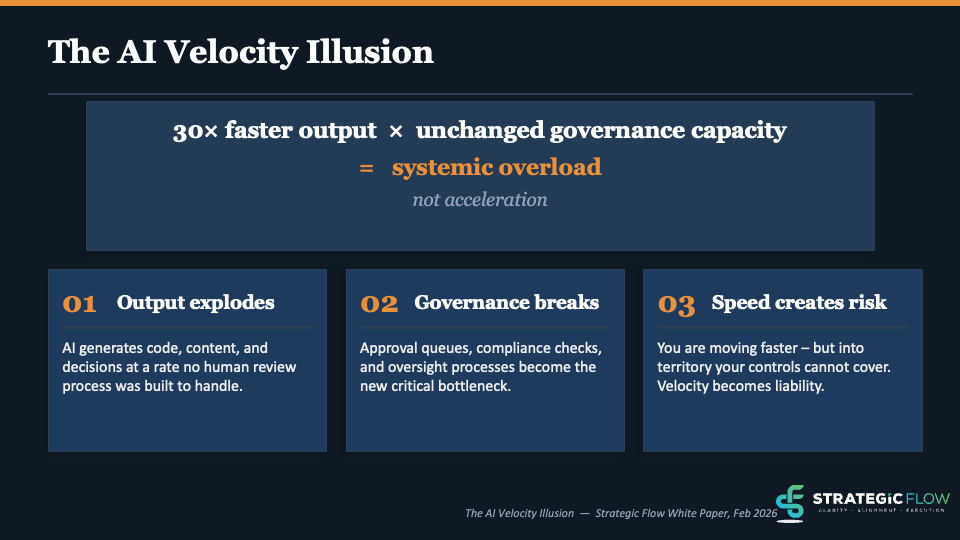
The concept of the AI Velocity Illusion
How governance becomes a bottleneck in AI-enabled organisations
Where AI should and should not be applied across the Wardley evolution cycle
The difference between AI-driven and AI-informed strategy
Why accountability cannot be delegated to AI
How OKRs and flow principles help organisations adopt AI safely
This presentation takes a look at how and where AI needs to dovetail with the strategy of an organisation.
It is targeted at leaders who are signing off on AI initiatives without the frameworks to evaluate them, and who may be accepting governance risks they don’t fully understand. The aim is to help prevent leaders being outmanoeuvred — by vendors, by consultants, or by staff within their organisations who, whilst tech-savvy, don’t understand the needs of the organisation in the same way as leadership. The slides contain practical, actionable, advice that leaders can take away and implement now.
What this presentation is (and isn’t)
This presentation is:
A practical framework for thinking about AI strategy in an agentic world.
It explores how organisations can apply AI safely and effectively by focusing on governance, accountability, systems thinking, and organisational design. Drawing on concepts such as Wardley Mapping, OKRs, Work in Progress limits, Martec’s Law, and the AI Velocity Illusion, it provides a strategic lens for deciding where AI should and should not be deployed
Intended for leadership teams, technology executives, transformation leaders, and decision-makers responsible for turning AI potential into business outcomes. on execution confidence, not OKR “compliance”
This presentation is not:
A technical implementation guide
An explain how to build AI models, develop agents, fine-tune LLMs, or deploy specific AI technologies
A prediction of future AI capabilities or a catalogue of AI tools
Instead, it focuses on the organisational and strategic questions that must be answered before technology decisions are made. The argument throughout is that AI amplifies the systems it operates within. If governance, accountability, and organisational design are weak, AI accelerates those weaknesses. If they are strong, AI can become a powerful force multiplier.
(Free. No registration required.)
Four sample learnings from the presentation
What the right question is to help you frame your organisation’s use of AI (and what the wrong one is).
Why most organisations and taking the wrong approach to implementing AI.
Why it’s dangerous to outsource strategic thinking to AI.
The different ways to get most benefit from AI at the different stages of product and service evolution.
Common questions about AI and Strategy
An agentic world is one in which AI systems increasingly perform tasks, make decisions, and execute actions with limited human intervention. Rather than simply responding to prompts, agentic systems can pursue objectives, interact with other systems, and operate autonomously within defined boundaries.
The AI Velocity Illusion describes a situation where AI dramatically increases output, but governance, oversight, and decision-making capacity remain unchanged. Organisations appear to be moving faster, but are actually creating larger queues, more risk, and greater systemic overload.
AI can generate outputs far faster than most organisations can review, approve, or govern them. Without appropriate controls, speed becomes a source of risk rather than competitive advantage. Governance ensures that AI operates within intentional boundaries.
An AI-driven strategy allows technology to determine priorities and direction. An AI-informed strategy uses AI to support analysis and execution while humans retain responsibility for intent, prioritisation, governance, and accountability.
Wardley Mapping helps organisations understand where a capability sits on its evolutionary journey, from novel and uncertain through to stable and commoditised. Different levels of uncertainty require different levels of human involvement, making it a useful tool for deciding where AI should be applied
Most organisations should begin by identifying repeatable, well-understood processes where rules are stable and outcomes are measurable. These areas tend to provide the safest and most effective opportunities for AI adoption.
No. The presentation argues that human judgment becomes more important, not less. As AI increases the volume and speed of activity, leaders must provide the intent, oversight, and accountability that AI systems cannot generate for themselves.
The material is designed for CEOs, CIOs, CTOs, Chief Transformation Officers, product leaders, technology leaders, board members, and anyone responsible for connecting AI investments to business outcomes.
Most AI failures are not technology failures. They occur because organisations automate activities without understanding the surrounding system. Poor governance, unclear ownership, conflicting priorities, and unmanaged work in progress often become the real bottlenecks long before the technology reaches its limits.
Continue Exploring
AI Strategy & Systemic Integration
Align AI capability with governance, operating model design, and business outcomes. Get targeted advice and consulting that means AI initiatives succeed.
Wardley Mapping
Build situational awareness and identify where AI can create genuine advantage with a two-day facilitated workshop specifically designed for leadership teams.
OKR Consulting
Translate strategic intent into measurable execution while avoiding overload.
AI Velocity Illusion
Why faster output often creates larger queues, more risk, and less control.
Need Help Turning AI Ambition into Execution?
Many organisations are moving quickly with AI but struggle to convert that activity into measurable business outcomes.
The challenge is rarely the technology itself.
The real constraint is often governance, prioritisation, organisational design, or the ability to absorb change.
If you’re exploring AI strategy, governance, OKRs, Wardley Mapping, or the operating model required to support AI adoption at scale, we’d be happy to discuss your situation.
Book an Initial ConversationPrefer to speak in person?